Soaked dates vs Dried dates

Soaked Dates vs Dried Dates: Benefits, Nutrition, and What Science Says

You may have heard that soaking dates overnight makes them easier to digest, improves mineral absorption, and even removes some of the compounds that can interfere with nutrient absorption. It sounds convincing, but how much of it is actually supported by science?

Dates are already a nutrient-rich dried fruit, providing carbohydrates, fibre and several minerals. So what really changes when you leave them in water overnight? Does soaking make dates healthier, or does it mainly change their texture?

In this guide, we’ll compare soaked and dried dates, look at what happens to their nutrition during soaking, explain when soaking may actually be useful, and separate the well-supported facts from the popular claims that don’t have enough evidence behind them.

What Actually Happens When You Soak Dates Overnight?

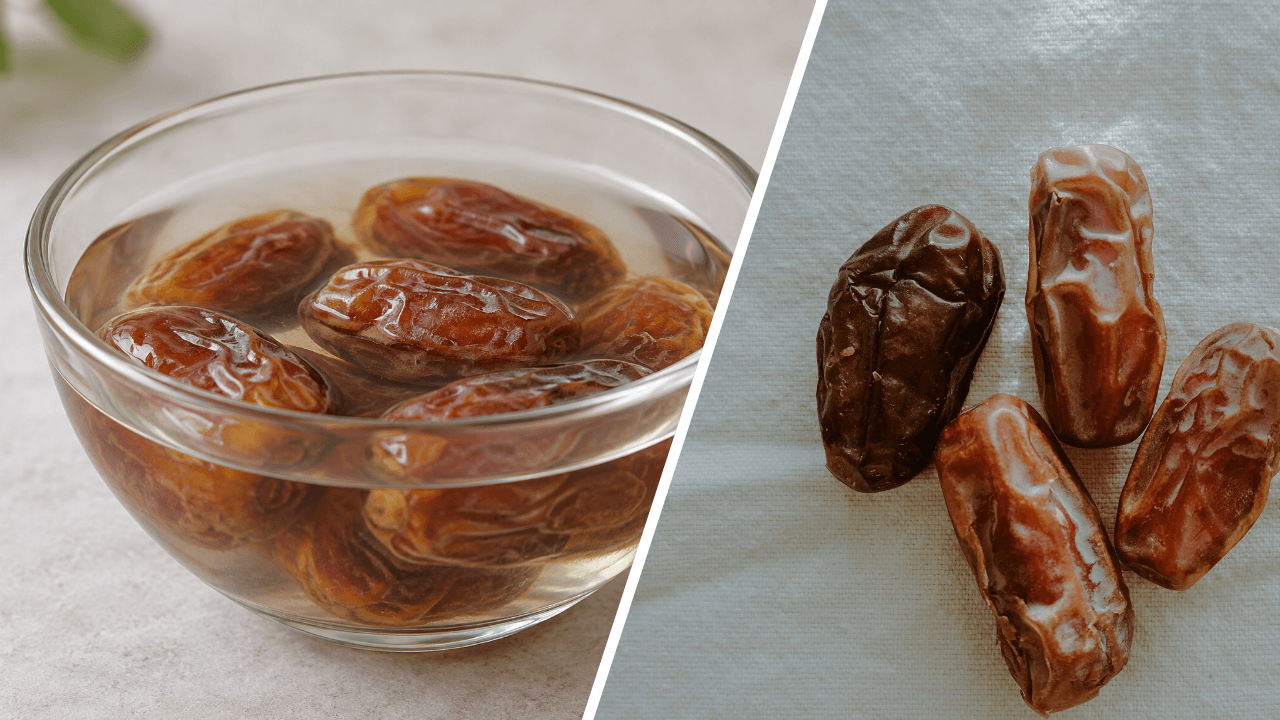
Soaking dates overnight mainly changes their texture. The dried fruit absorbs water, becomes softer and plumper, and is easier to chew, mash or blend. That is the most noticeable difference between a soaked date and one eaten straight from the pack.

Dates naturally contain polyphenols, including tannins. These compounds are part of the fruit’s natural composition and vary depending on the variety and how ripe the date was when harvested. But there is an important point here: soaking a date does not automatically make its nutrients more available or turn it into a nutritionally superior food. There isn’t enough direct evidence to say that overnight soaking removes a meaningful amount of tannins or improves mineral absorption.

Some compounds can move from the fruit into the soaking water. This is one reason the soaked date and its soaking water may not have exactly the same composition as the original fruit. However, the main nutritional components of dates — particularly their carbohydrates and dietary fiber — are still present in the fruit after soaking.

So, if you like soaked dates, the practical benefit is simple: they become softer, easier to eat and useful in foods such as smoothies, date paste and desserts. You don’t need to think of soaking as a way to “activate” the date.

Reality check: Soaking dates overnight is a preparation method, not a nutritional transformation. If you enjoy the softer texture, go ahead and soak them. But there is no good evidence that an overnight soak turns ordinary dates into a significantly more nutritious version of the same fruit.

Head-to-Head Comparison: Soaked vs. Dried Dates

The simplest way to look at it is this: soaking changes the texture and water content of dates, but it does not turn them into a nutritionally different food.

For the dried date values below, we can use the Indian Food Composition Tables (IFCT 2017), which list “Dates, dry, pale brown (Phoenix dactylifera)” as food code E017. The table provides measured nutrient values per 100 g of the edible portion.

There is no separate IFCT entry for “soaked dates,” so it would be misleading to give exact per-100 g nutrient values for soaked dates without measuring the water absorbed during soaking.

Parameter Dried Dates per 100 g Change After Soaking
Energy (kcal) 320 Water adds weight, calories per 100 g lower
Total dietary fibre (g) 8.95 No established major nutritional change
Insoluble fibre (g) 7.53 No established major nutritional change
Soluble fibre (g) 1.42 Some soluble compounds may move into soaking water
Protein (g) 2.45 No established major change
Fat (g) 0.35 No meaningful change expected
Carbohydrate (g) 74.91 Water dilutes concentration per 100 g
Sucrose (g) 45.58 Some soluble sugars may move into soaking water
Iron (mg) 3.20 No good evidence soaking improves absorption
Calcium (mg) 71.20 No good evidence soaking improves absorption
Magnesium (mg) 73.79 No good evidence soaking improves absorption
Phosphorus (mg) 73.02 No established change
Potassium (mg) 804 Some minerals may leach into water
Texture Firm and chewy Softer and easier to chew
Preparation Ready to eat Usually soaked for several hours or overnight

The important point is that soaking adds water rather than nutrients. A soaked date can weigh more because it has absorbed water, so comparing 100 g of soaked dates with 100 g of dried dates can make the soaked version appear lower in calories and nutrients simply because part of that weight is now water.

Dates also contain polyphenols, including condensed tannins, but there isn’t enough direct evidence to quantify how much of these compounds an overnight soak removes from ordinary dried dates.

Soaking can therefore be useful for texture and preparation, but it shouldn’t be described as a proven way to “unlock” the nutrients in dates.

Full nutritional breakdown of khajoor →

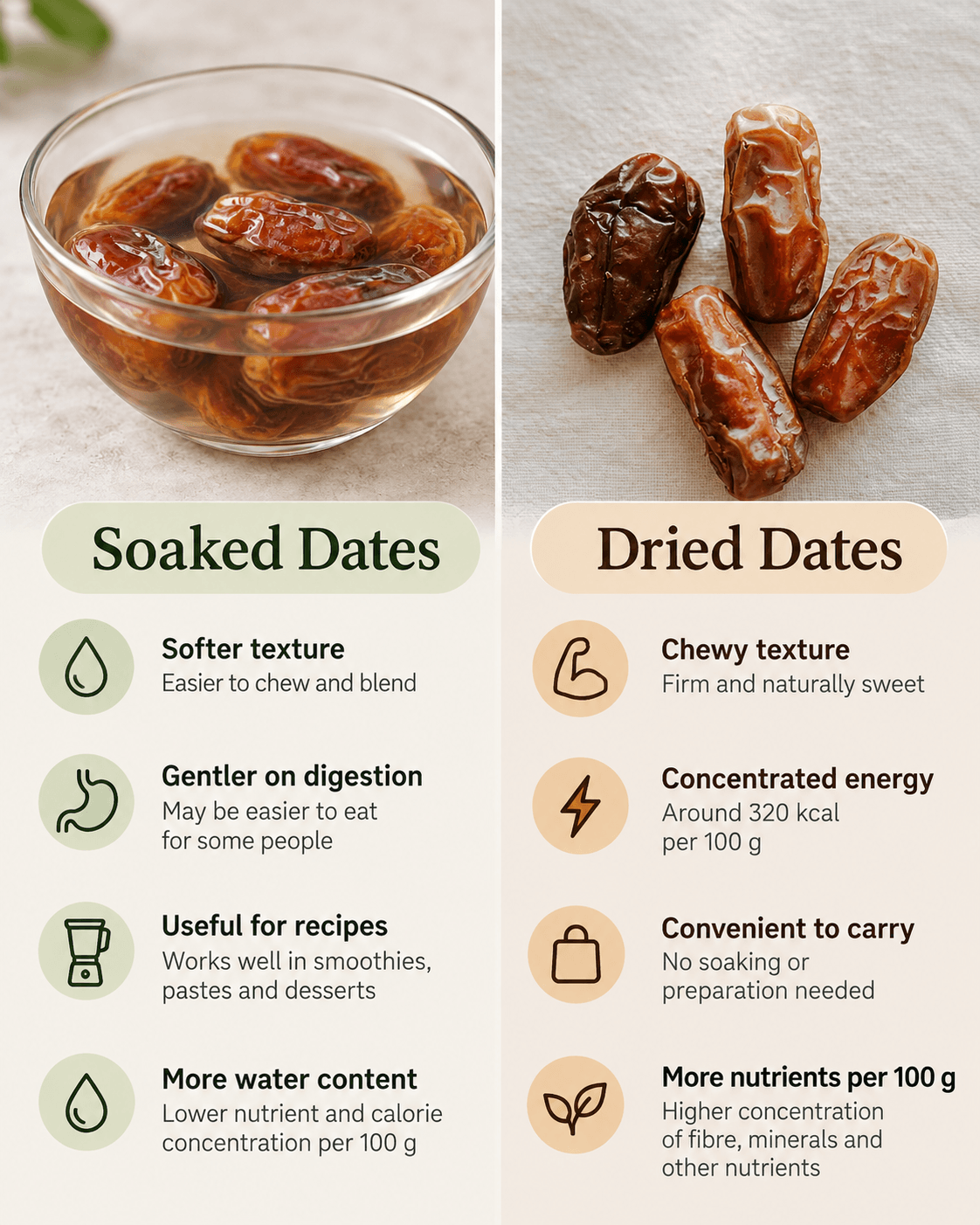
Soaked vs Dried Dates Comparison Infographic

What Are the Benefits of Soaked Dates?

Soaking dates overnight doesn’t create a new set of nutrients or make the fruit dramatically healthier. The clearest benefit is much simpler: it changes the texture. Dried dates absorb water and become softer, which can make them easier to chew, mash and blend.

Dates themselves are already a nutritious dried fruit, providing carbohydrates, dietary fibre and several minerals. Soaking is best thought of as a preparation method rather than a way to “activate” their nutrition.

Softer Texture and Easier to Use

This is the most practical reason to soak dates. After several hours in water, the fruit becomes softer and can be easier to chew or blend into smoothies, shakes, date paste and homemade desserts.

For people who simply prefer a softer texture, soaking can make dates more convenient to include in meals.

Does Soaking Improve Iron Absorption?

This claim needs some caution.

Dates contain iron, and plant-based iron is less readily absorbed than haem iron from animal foods. Certain plant compounds, including some tannins and phytates, can reduce mineral absorption under particular dietary conditions. However, research on tannins and iron absorption is not as straightforward as the common “tannins block iron” statement suggests.

More importantly, there is not enough direct evidence to show that soaking edible dried dates overnight removes enough of these compounds to meaningfully improve iron absorption.

Soaked dates should not be promoted as an iron-absorption strategy.

What About Phytic Acid?

Phytic acid is another compound that can affect the absorption of minerals such as iron and zinc in plant-based diets. Soaking can reduce phytate in some plant foods, but that doesn’t mean the same effect has been demonstrated for ordinary dried date fruit.

One study did report reductions in tannins and phytates during processing of date seeds, but date seeds are a different part of the fruit and the study involved prolonged soaking followed by sprouting and roasting. It cannot be used as proof that overnight soaking of the edible date has the same effect.

A Practical Option During Ramadan

Soaked dates can be convenient during Ramadan because their softer texture makes them easy to eat and incorporate into drinks or other foods. But there is no need to soak dates for a special nutritional benefit. Both soaked and unsoaked dates can be part of a balanced diet.

If dates are being prepared for young children, soaking can make them softer, but it does not remove the need for age-appropriate preparation and supervision because dates can still present a choking hazard.

The Bottom Line

Soaking dates is useful mainly for texture, convenience and preparation. It may change the amount of water and some soluble compounds in the fruit, but current evidence does not justify saying that overnight soaking significantly improves iron absorption, removes phytic acid, or makes dates easier to digest.

If you enjoy soaked dates, there is nothing wrong with the habit. Just don’t feel that you are missing a major nutritional benefit if you prefer to eat them straight from the pack.

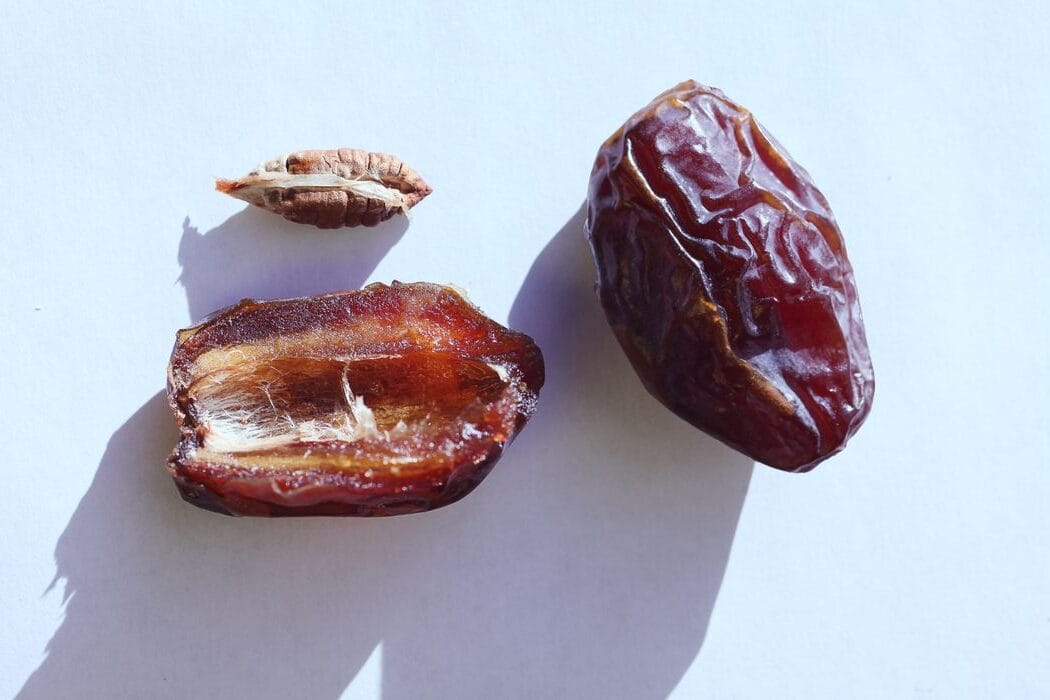
Close-up flat lay of whole and half dates with seed on a white background.

When Are Dried Dates the Better Choice?

Dried dates make more sense when you want convenience, concentrated energy, or a firmer texture. You can eat them straight from the pack, carry them easily, and use them in recipes without any preparation.

Convenient Source of Carbohydrates

At around 320 kcal per 100 g, dried dates are relatively energy-dense because much of their original water has been removed. IFCT 2017 also shows that dates contain naturally occurring sugars, including sucrose, fructose and glucose.

That makes dates a convenient carbohydrate-rich snack when you need something portable before a workout, during travel, or between meals. However, the amount you eat matters — 100 g is a fairly large serving of dates, so a few dates may be more practical for most people.

More Nutrients in Each 100 g

Because soaking adds water, 100 g of soaked dates would contain more water and therefore a lower concentration of calories and nutrients per 100 g than the original dried fruit.

That doesn’t mean soaking removes the nutrition from each individual date. It simply means 100 g of soaked dates and 100 g of dried dates are not directly comparable by weight.

For reference, IFCT 2017 lists about 8.95 g of dietary fibre per 100 g of dried dates, including 7.53 g insoluble and 1.42 g soluble fibre.

No Soaking or Preparation Required

This is probably the biggest practical advantage.

Dried dates can be eaten immediately, packed for travel, added to oats or snacks, or chopped into recipes. If you prefer their natural chewy texture, there is no need to soak them before eating.

Soaking is mainly a texture and preparation choice, rather than a necessary step for getting the nutrition from dates.

Better for Some Recipes

The firmer texture of dried dates works well in energy bars, stuffed dates, chopped snack mixes, chutneys and many traditional sweets.

Soaked dates are more useful when you want a soft, blendable texture; for example, in smoothies, date paste, sauces or desserts.

The choice is therefore mostly practical: use dried dates when you want convenience and concentrated food by weight; soak them when you want a softer, easier-to-blend texture.

How to Soak Dates Correctly

Soaking dates is simple. You don’t need a complicated method; the main goal is to soften the dried fruit and make it easier to eat or use in recipes.

Use cool or room-temperature water.
Place the dates in enough drinking water to completely cover them. Cool or room-temperature water works well for overnight soaking.

Soak for several hours or overnight.
There is no scientifically established soaking time that is required to “activate” nutrients in dates. For convenience, many people simply soak them overnight. If you’re soaking them during warm weather, refrigeration is a safer option.

What should you do with the soaking water?
You don’t need to discard it because of a proven “tannin removal” effect. Some water-soluble compounds, including some sugars, can move into the water during soaking. If you’re making a smoothie or date paste, you can use some of the soaking water to adjust the consistency.

Remove the pits when convenient.
For eating whole, you can remove the pit before or after soaking. If you’re making a paste or blending the dates, removing the pits beforehand is usually easier.

Refrigerate leftover soaked dates.
Once dates have been soaked, treat them as a moist, perishable food rather than as shelf-stable dried fruit. Transfer them to a clean covered container and refrigerate them. Use them promptly and discard them if they develop an unusual smell, appearance or taste.

How much should you soak?
A practical serving might be around 3–4 dates, although the weight varies considerably with date size and variety. If the portion weighs around 40–55 g, it would provide roughly 3.6–4.9 g of dietary fibre, 1.3–1.8 mg of iron and 320–440 mg of potassium, based on the IFCT 2017 values for dried pale-brown dates. The actual amount will vary with the size and variety of the dates.

When Is the Best Time to Eat Soaked Dates?

There isn’t a scientifically established “best time” to eat soaked dates. The right timing depends more on why you’re eating them, your portion size, and how they fit into your overall diet.

In the Morning

Soaked dates can be a convenient addition to breakfast if you enjoy their softer texture. You can eat them alongside other foods or blend them into a smoothie or breakfast bowl.

There is no good evidence that eating dates on an empty stomach makes their minerals, such as iron or magnesium, significantly easier for your body to absorb.

Before Exercise

Dates provide carbohydrates, making them a practical snack before physical activity. A small portion can be useful when you want some carbohydrate without preparing a full meal.

You don’t need to soak them for this purpose. Soaked dates may simply be easier to chew or blend, while dried dates are more convenient to carry.

The ideal timing depends on the person, the type of exercise, and the size of the snack. There is no evidence that everyone needs to eat soaked dates exactly 45 to 60 minutes before exercise.

During Ramadan

Dates are traditionally eaten at Iftar, making them a familiar way to include carbohydrates when breaking the fast. They can also be included at Sehri as part of a balanced meal.

Soaking is optional. If you prefer a softer texture, soaked dates can be convenient, but they should not be considered a special hydration treatment. Water and other fluids are still the main source of hydration.

What About Eating Dates at Night?

There is no general rule that dates must be avoided at night.

Dates contain naturally occurring sugars and carbohydrates, so portion size still matters, particularly for people who need to manage their carbohydrate intake or blood glucose. Research on several date varieties has found low to moderate glycemic indices, and clinical studies have not consistently shown that moderate date consumption worsens blood glucose control.

So there is no need to avoid a few dates simply because it is evening. What matters more is how they fit into your overall diet and energy intake.

The Bottom Line

Eat soaked dates when they fit your routine, not because a particular time makes them more nutritious.

Morning, before exercise, at Iftar, or in the evening can all be reasonable times. Soaking mainly changes the texture and water content, not the time at which the nutrients become more effective.

Soaked or Dried Dates: Which Should You Choose?

Soaking dates overnight isn’t a nutritional transformation. It mainly adds water, softens the fruit, and makes it easier to chew, blend or use in certain recipes. Some soluble compounds can also move into the soaking water, but there isn’t enough evidence to say that overnight soaking significantly improves mineral absorption or removes enough anti-nutrients to make dates healthier.

That doesn’t make soaked dates pointless. If you enjoy their softer texture, find them easier to use in smoothies or date paste, or simply prefer them that way, soaking is perfectly reasonable. If you want a convenient, portable and more concentrated source of carbohydrates, dried dates work just as well.

The real choice is not between a “healthy” date and an “unhealthy” one. It’s about how you prefer to eat them and how they fit into your diet.

Soak them if you like the texture. Eat them dried if you prefer the convenience. You don’t need to soak dates to get their basic nutritional benefits.

Frequently Asked Questions

Can I drink the water used to soak dates?

Yes, you can, although you don't have to. Some soluble compounds and sugars can move into the soaking water, so using it in a smoothie or recipe is one option. There is no good evidence that you need to discard the water to remove tannins or phytic acid from dates. The brown or cloudy appearance of the water also does not prove that the soaking has removed a particular amount of anti-nutrients.

How many soaked dates should I eat per day?

There is no scientifically established daily requirement for soaked dates. A small serving of 2–4 dates can be a practical starting point for many adults, but the actual amount depends on the size of the dates and your overall diet. Dried dates are concentrated in carbohydrates and calories, so larger portions can add up quickly. For example, if your dates are large, four dates can provide considerably more energy than four small dates.

Can I soak dates in milk instead of water?

Yes. Soaking dates in milk can soften them and works well for recipes such as smoothies, shakes, date milk and desserts. The milk will also add protein, fat, carbohydrates and calories to the final preparation. There is no good reason to choose water over milk specifically for tannin removal, since the effect of overnight soaking on tannins in edible date fruit has not been established.

Do soaked dates have fewer calories than dried dates?

Not simply because they are soaked. Soaking adds water, so the dates weigh more and the calorie concentration per 100 g of the soaked fruit will be lower. However, the calories in the original date have not disappeared. If you soak one date, its total energy content will remain broadly similar, although some soluble compounds can move into the soaking water.

Are soaked dates better for people with diabetes?

There is no evidence that soaking makes dates significantly better for blood glucose control. The sugars in the fruit are still present after soaking. However, dates themselves do not automatically have to be excluded from a diabetes-friendly diet. Studies of different date varieties have generally found low to moderate glycemic indices, and randomized trials have found that moderate date consumption did not worsen glycemic control in people with type 2 diabetes. (pubmed.ncbi.nlm.nih.gov) (pubmed.ncbi.nlm.nih.gov)
For someone managing diabetes, portion size and the overall meal matter more than whether the dates were soaked. Individual blood glucose responses can vary, so people using glucose-lowering medication should follow their healthcare professional's dietary advice.

I forgot to soak the dates overnight. Can I do a quick soak?

Yes. If your goal is simply to soften the dates for blending or cooking, a short soak can help. There is no established minimum soaking time for obtaining a nutritional benefit from dates, so there is no need to leave them overnight if you're only looking for a softer texture.

Are soaked dates safe for children and pregnant women?

Soaking can make dates softer, but it does not eliminate choking risk. For young children, dates should be prepared according to the child's age and developmental stage rather than served whole simply because they have been soaked.
Dates can be included in a pregnancy diet as part of a varied eating pattern. Some clinical studies have investigated date consumption during late pregnancy, including effects on labour outcomes, but this does not mean that dates are required during pregnancy or that soaking provides a special pregnancy benefit. (pubmed.ncbi.nlm.nih.gov)
People with gestational diabetes should consider the carbohydrate content of dates within their overall meal plan and follow the dietary advice provided by their healthcare professional.
Disclaimer: This article is for general nutrition and educational purposes only. It is not a substitute for professional medical advice, diagnosis, or treatment. Individual nutritional needs can vary, especially during pregnancy, childhood, or when managing conditions such as diabetes. Consult a qualified healthcare professional for personalized advice.

Leave a Comment

Your email address will not be published. Required fields are marked *

Scroll to Top