15 High Protein Breakfasts with Protein and Calories
These 15 Indian breakfasts provide at least 12 g of protein per serving, with four options—paneer bhurji, a 3-egg omelette, paneer-stuffed moong chilla and soy-besan chilla—providing more than 20 g. Nutritional values are calculated using ICMR–NIN’s Indian Food Composition Tables (IFCT) 2017 for the listed ingredients and serving sizes. Values are estimates and may vary with ingredient quantities and preparation methods.
Disclosure: some links on this page are affiliate links. If you buy through them, Vitaroxi may earn a commission at no extra cost to you. They are limited to kitchen tools and do not affect any protein figure.
How much protein should an Indian breakfast have?
Aim for at least 12 g of protein at breakfast, with 20 g or more as a practical target for those who exercise regularly or want a more protein-rich meal. These are suggested benchmarks for this article, not official ICMR–NIN breakfast recommendations. The ICMR–NIN 2020 recommended dietary allowance (RDA) is 0.83 g of protein per kg of body weight per day—approximately 54 g for a 65 kg reference man and 45.7 g for a 55 kg reference woman (ICMR–NIN RDA note). A 12 g breakfast provides around 22–26% of these daily amounts.
Your daily protein requirement depends on body weight, activity level and fitness goals. The basic RDA provides a reference for most healthy adults, while people who exercise regularly or engage in strength training may benefit from higher intakes depending on their training and overall diet. There is no single breakfast target that suits everyone, so consider your total daily protein intake rather than focusing on one meal alone. Use our Protein Intake Calculator to estimate your daily needs.
The 12 g benchmark is a useful starting point because many cereal-based breakfasts provide relatively little protein on their own. In IFCT 2017, 50 g of raw poha provides approximately 3.7 g of protein, while 40 g of semolina (the base of upma) provides approximately 4.6 g. A breakfast made primarily from either ingredient may therefore fall short of the target unless you add protein-rich foods such as milk, curd, paneer, eggs, pulses or soy. The recipes below show how to build more protein into familiar Indian breakfasts without abandoning traditional foods.
Which Indian breakfasts are highest in protein? All 15 compared
Paneer-stuffed moong chilla leads this comparison at an estimated 24.2 g of protein per serving, while moth usal with pav provides 12.1 g. The table compares 15 Indian breakfasts using the stated ingredient quantities. Protein and energy values are estimates calculated from ingredient-level food composition data, not laboratory analysis of prepared meals.
Weighing portions makes these numbers repeatable at home. A digital kitchen scale does it: [digital kitchen scale].
Which Indian breakfasts have more than 20 g of protein?
Four of the 15 breakfasts in this comparison are estimated to provide more than 20 g of protein per serving. Each combines a protein-rich ingredient—paneer, eggs or soybean—with a pulse or wheat-based component. Based on the current estimates, soy-besan chilla provides the most protein per 100 kcal (about 6.8 g), while paneer bhurji with two rotis has the highest energy content (487 kcal).
1. Paneer-stuffed moong chilla: 24.2 g protein, 408 kcal
This serving combines 60 g of moong dal with 50 g of paneer, along with onion and oil for preparation. The moong dal and paneer are the main protein sources. According to IFCT 2017, paneer contains 18.86 g of protein per 100 g.
2. Three-egg masala omelette with roti: 23.8 g protein, 382 kcal
This breakfast includes three eggs (150 g edible portion), one roti made with 30 g of atta, onion, tomato and oil. Eggs provide most of the protein, with additional protein from the atta. It is the only egg-based breakfast among the 15 options; the other 14 are vegetarian.
3. Soy-besan chilla: 23.3 g protein, 344 kcal
This recipe combines 40 g of dry soybean with 40 g of besan, along with onion and oil. Soybean and besan are the main protein sources. Using the stated IFCT 2017 value of 35.58 g of protein per 100 g for brown soybean, 40 g supplies approximately 14.2 g of protein. Soak the whole soybeans overnight, grind them with the besan and cook the chilla thoroughly on both sides.
4. Paneer bhurji with two rotis: 21.2 g protein, 487 kcal
This plate contains 75 g of paneer and 60 g of atta for two rotis, along with onion, tomato and oil. Paneer and wheat flour provide most of the protein. At the current estimate of 487 kcal, this is the highest-calorie breakfast among the 15 options, making it a potentially suitable choice for people who need a more energy-dense meal.
Which Indian breakfasts provide 12–15 g of protein without paneer or eggs?
Eleven of the 15 breakfasts in this comparison fall within the 12–15 g protein range without paneer or eggs, based on the current estimates. They combine pulses, cereals, milk and nuts in different proportions. Pairing cereals with pulses can improve the overall essential amino acid balance of a vegetarian diet, as described in ICMR-NIN's Dietary Guidelines for Indians 2024.
North and West India
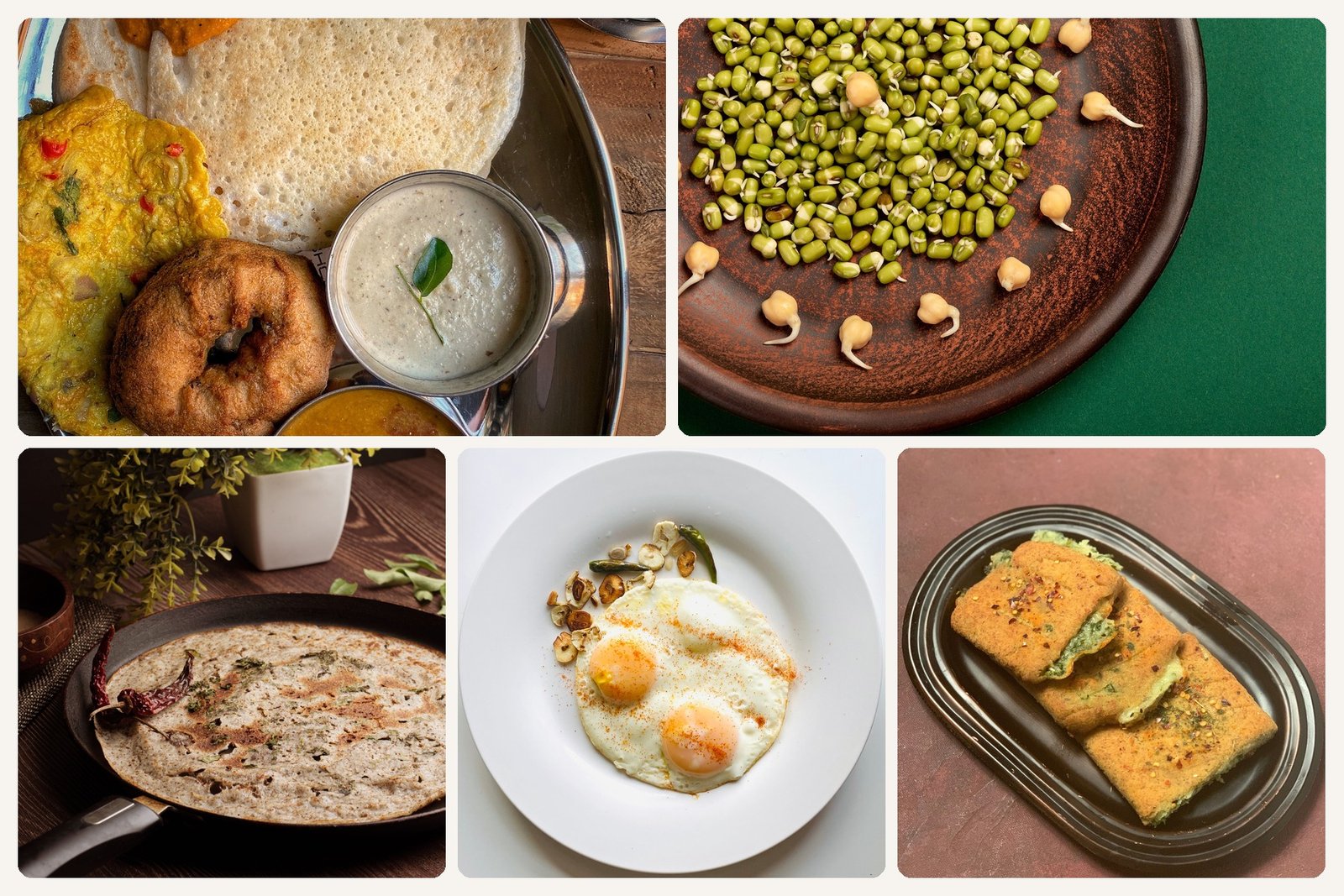
- Moong dal chilla (14.8 g protein, 255 kcal): Made with 60 g of moong dal, onion and oil. The moong dal provides most of the protein, making this one of the lower-calorie options on the list.
- Vegetable dalia with moong dal (14.1 g, 338 kcal): Wheat dalia and moong dal cook together with carrot, peas, onion and oil for a one-pot breakfast.
- Besan chilla (13.4 g, 257 kcal): Made with besan, onion and oil. The protein estimate should be checked against the exact food-composition entry used for besan.
- Moth usal with pav (12.1 g, 334 kcal): A moth-bean curry served with pav. IFCT 2017 reports 19.75 g of protein per 100 g of moth bean, making it a useful pulse-based option.
Central and Western India
- Sprouts poha (14.5 g, 403 kcal): Made with poha, dried whole green gram measured before soaking and sprouting, peanuts, onion and oil. The added pulses and nuts raise the estimated protein content considerably compared with plain poha.
South India
- Pesarattu (14.6 g, 267 kcal): An Andhra-style dosa made from whole green gram batter with a little rice, onion and oil.
- Moong-peanut upma (14.1 g, 333 kcal): Combines semolina with whole green gram, peanuts, onion and oil. The pulses and nuts add protein beyond what the semolina provides alone.
- Mixed-dal adai (13.4 g, 307 kcal): A savoury rice-and-lentil pancake made with rice, a mixture of toor, chana, urad and moong dals, onion and oil.
- Ragi porridge with milk and peanuts (12.2 g, 320 kcal): Made with ragi, cow's milk and peanuts. The milk and peanuts provide much of the protein, while ragi contributes calcium and fibre.
East India
- Chakuli pitha with ghuguni (14.1 g, 397 kcal): An Odisha-style combination of rice-and-urad pitha with ghuguni made from dried peas, potato, onion and oil. The dried peas are a major protein contributor.
A simple option for any day
- Sprouted moong chaat (14.1 g, 192 kcal): Made with 60 g of dried whole green gram measured before soaking and sprouting, plus onion and tomato. At the current estimates, it provides about 7.3 g of protein per 100 kcal, making it the highest protein-per-calorie option in this list.
For the two sprouted dishes, a sprouting jar or tray does the job at home: [sprouting jar].
Are idli and dosa high-protein breakfasts?
Plain idli and dosa with sambar provide some protein, but their totals depend on the batter proportions and serving size. In the example recipes used here, both provide around 11–12 g of protein per serving. Adding paneer, eggs or a larger serving of dal-rich sambar can increase the protein content.
Is the protein in Indian breakfasts good quality?
Protein quality depends on more than the number of grams on your plate. It also depends on the essential amino acids a food provides and how well the body digests and absorbs them.
The Digestible Indispensable Amino Acid Score (DIAAS) is one way to assess protein quality. In a published comparison, cow's milk scored 1.16 and boiled whole egg 1.13, while soya flour scored 0.89, cooked peas 0.58 and wheat 0.45. These are scores for specific foods and preparations, not universal ratings for every meal made with those ingredients. Source: published DIAAS comparison table.
Why combining pulses and cereals can help
Pulses and cereals have different essential amino acid profiles. Combining them can improve the balance of amino acids supplied by a meal, although the effect depends on the ingredients and their proportions.
In a 2021 study using a pig model, cooked mung beans scored 93 on the DIAAS scale for older children, adolescents and adults, millet scored 22, and a mung bean–millet blend scored 66. The blend improved on millet alone but did not score higher than mung beans alone. This illustrates why combining foods can improve amino acid balance without automatically producing a higher score than every individual ingredient. Source: Han et al., 2021.
This is relevant to breakfasts such as moong dal chilla, pesarattu and mixed-dal adai, where pulses provide much of the protein. However, the study tested specific cooked ingredients and blends, so its scores should not be assigned directly to these complete recipes.
Does fermentation improve protein digestibility?
Fermentation can influence protein digestibility. In a study of millet-based breakfast preparations, average in-vitro protein digestibility was 78.7% for idli, 71.5% for dosa and 61.8% for upma. The researchers reported that fermentation improved digestibility in idli and dosa batters. These results apply to the millet preparations tested under laboratory conditions; they are not direct measurements of protein absorption in people. Source: Journal of Research, PJTSAU.
The practical takeaway: Look beyond protein grams alone. Pulses, cereals, dairy and eggs contribute different amounts and types of protein, while preparation methods can affect digestibility. A varied diet with suitable portions is more informative than assuming that one protein-quality score applies to every meal.
How do I calculate the protein in my own breakfast?
To estimate the protein in your breakfast, enter each ingredient and its quantity in the Indian Recipe Planner & Nutrition Calculator. Divide the recipe's total protein by the number of servings to estimate the protein per serving.
Comparing ingredients? Use the Food Comparison Tool to compare their nutritional values. You can also use the Nutrient Gap Calculator to review your estimated nutrient intake and identify potential gaps.
For ingredient-level nutrition data, explore the Vitaroxi database pages for pulses and legumes, meat, fish and eggs, milk and dairy and cereals and millets.
For more guidance, read Complete Protein for Vegetarians: Indian Diet Guide and 10 Pocket-Friendly High-Protein Foods in India. If food costs are also a concern, try the Indian Diet Budget Planner.
Sources and how the figures were calculated
Protein and energy estimates are based primarily on the Indian Food Composition Tables 2017 (IFCT 2017), published by the Indian Council of Medical Research–National Institute of Nutrition. Nutrient values are applied to the ingredient quantities listed for each Vitaroxi recipe. IFCT reports energy in kilojoules; values are converted to kilocalories using 1 kcal = 4.18 kJ. Added cooking oil is included in the recipe's energy calculation. Cooking-related changes in nutrient content and water loss or gain are not modelled, so actual values may vary with preparation and serving size.
Ingredient assumptions
- Besan: Where a directly matching food-composition entry is unavailable, Bengal gram data are used as a proxy. This is an approximation, not an exact measurement of besan.
- Eggs: The omelette calculation uses the edible portion of raw whole egg. An approximate 50 g edible portion per large egg is used as a serving reference.
- Soy-besan chilla: Soybean quantities refer to dry brown soybeans before soaking. The recipe assumes whole soybean rather than soy flour.
- Pav and milk: Pav is approximated using refined wheat flour data where a matching entry is unavailable. Milk is weighed as 200 g.
- Serving sizes: Vitaroxi uses standardised recipe quantities informed by food-exchange references and published serving examples. These are working recipe assumptions, not universal Indian serving sizes. All ingredient weights refer to the raw or dry ingredient unless otherwise stated.
References
- ICMR–NIN, Indian Food Composition Tables 2017 (official IFCT 2017 publication).
- ICMR–NIN, A Brief Note on Nutrient Requirements for Indians, the Recommended Dietary Allowances (RDA) and Estimated Average Requirements (EAR), 2020 (PDF).
- ICMR–NIN, Dietary Guidelines for Indians 2024 (overview via The South First).
- IIT Kanpur, Food Exchange List.
- DIAAS and PDCAAS comparison table and Frontiers in Nutrition.
- Han et al. (2021), Pulse and cereal blends.
- Millet-based South Indian breakfasts and in-vitro protein digestibility.
Devi and Rajendran (2021), Millet-legume dosa