Best Vitamin B12 Foods in an Indian Diet
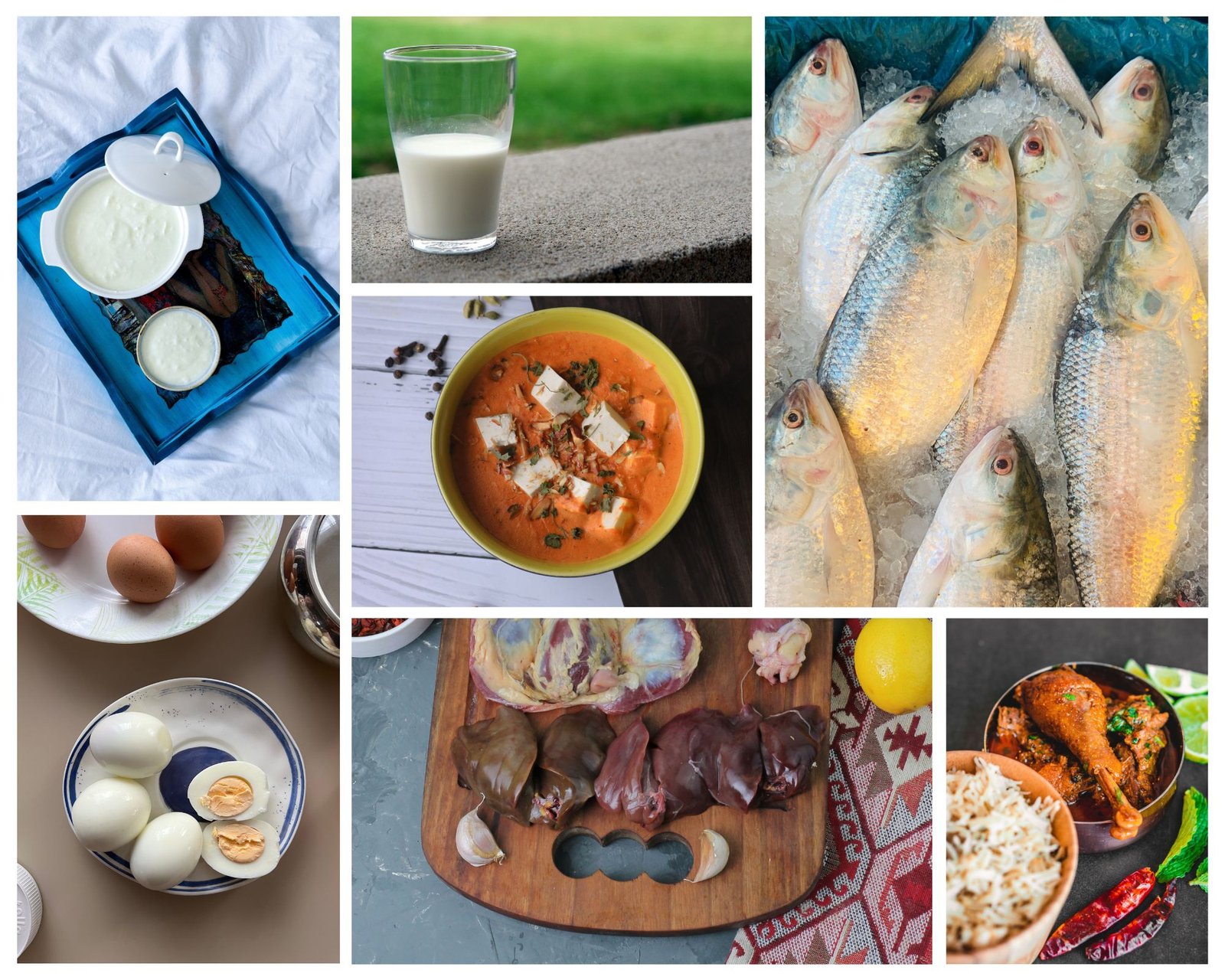
Vitamin B12 is found naturally mainly in animal-derived foods such as fish, meat, liver, eggs and dairy. Most unfortified plant foods do not provide reliable amounts of vitamin B12, although fortified foods can be a useful source. This matters in India, where many people eat little or no meat and may assume that foods such as dal, roti and sabzi cover all their nutritional needs.
The Dietary Guidelines for Indians 2024 from ICMR-NIN report vitamin B12 deficiency in 13.8% of children aged 1–4, 17.2% of those aged 5–9 and 30.9% of those aged 10–19. That last figure means nearly one in three children and adolescents in the 10–19 age group in the cited survey had vitamin B12 deficiency.
How much vitamin B12 do you need every day?
The ICMR-NIN 2020 Recommended Dietary Allowance (RDA) for vitamin B12 is 2.2 µg per day for adult men and women. The recommended intake varies by life stage, with higher amounts recommended during pregnancy and breastfeeding.
| Group | Vitamin B12 per day (µg) | Note |
|---|---|---|
| Infants (0–6 months) | 1.2 | RDA listed by ICMR-NIN 2020 |
| Infants (6–12 months) | 1.2 | RDA listed by ICMR-NIN 2020 |
| Children (1–3 years) | 1.2 | Lower than the adult RDA |
| Children (4–6 years) | 2.2 | Adult-level RDA |
| Children (7–18 years) | 2.2 | Same RDA as adults |
| Adults (men and women) | 2.2 | ICMR-NIN 2020 RDA |
| Pregnancy | 2.45 | About 0.25 µg/day above the adult RDA |
| Breastfeeding | 3.2 | About 1.0 µg/day above the adult RDA |
The ICMR-NIN 2020 tables specify 2.2 µg/day for adults, 2.45 µg/day during pregnancy, and 3.2 µg/day during lactation. Children have age-specific recommendations, with 1.2 µg/day for younger children and 2.2 µg/day from age 4 onward.
The ICMR-NIN framework retains 2.2 µg/day for older adults. However, ageing can affect vitamin B12 absorption, particularly when B12 is obtained from food. This means that meeting the RDA through ordinary food intake and actually absorbing enough B12 are not always the same thing. For older adults, fortified foods or supplements may sometimes be recommended by a healthcare professional depending on diet, absorption and individual circumstances.
The RDA is a recommended daily intake, not a minimum amount that must be consumed at exactly the same time every day. Vitamin B12 is a water-soluble vitamin, but the body stores substantial amounts, so short-term variation in intake does not mean that a person immediately becomes deficient.
For most healthy adults, the practical target is therefore to regularly obtain adequate vitamin B12 from the diet or appropriately fortified foods, rather than focusing on hitting exactly 2.2 µg every single day.
Best Vitamin B12 Foods in an Indian Diet
India’s IFCT 2017 does not report vitamin B12 in its current food-composition tables. However, the IFCT 2017 publication discusses B12 data from earlier Indian food-composition tables, including the 1971 and 1989 editions.
For the values below, we therefore use USDA FoodData Central where a suitable record is available. Values are approximate and can vary with species, cut, preparation, brand and fortification.
Non-vegetarian sources
| Food | Vitamin B12 per 100 g | Everyday reality |
|---|---|---|
| Chicken liver (cooked) | 16.9 µg | Very concentrated source; a small portion provides a substantial amount of B12 |
| Sardines | 8.9 µg | An affordable fish option in many parts of India |
| Mackerel (bangda; grilled) | 5.0 µg | A useful fish source; B12 varies by species and preparation |
| Hilsa (ilish) | 4.0 µg | A B12-containing fish, but values depend on the specific Indian food and source |
| Crab (varies by species) | 3.2 µg | Useful source where commonly eaten; species and preparation matter |
| Mutton/lamb | 2.9 µg | Provides B12, although typical portions are much smaller than 100 g |
| Egg (whole) | 0.89 µg | About 0.4–0.5 µg per large egg |
| Chicken breast (cooked) | 0.34 µg | Contains B12, but considerably less than liver or fish |
USDA-derived values for chicken liver, sardines and egg are documented in FoodData Central records; for example, cooked chicken liver provides 16.85 µg/100 g, sardines 8.94 µg/100 g and whole raw egg 0.89 µg/100 g.
Vegetarian sources
| Food | Vitamin B12 | Everyday reality |
|---|---|---|
| Milk | ~0.56 µg/100 g | Roughly 1.3–1.4 µg in a 240 ml glass, depending on the milk |
| Curd (dahi) | ~0.37 µg/100 g | A 150–170 g bowl provides roughly 0.6 µg |
| Paneer | ~2.6 µg/100 g | Can contribute B12, but actual values vary between products |
| Cheese | Varies by type | Can contribute B12; check the product's nutrition data |
| Fortified foods | Varies | Check the label because B12 content depends entirely on fortification |
Milk, curd, paneer and cheese can contribute vitamin B12, but the amount varies considerably between foods and products. Fortified foods can also provide B12, but their contribution depends on the amount added, so the nutrition label is the appropriate source for a specific product.
The global top sources include foods such as beef liver, clams and oysters, which can contain very high amounts of vitamin B12. Fortified foods can also provide substantial amounts. However, these foods are not necessarily practical or commonly consumed in most Indian households, so everyday choices such as dairy, eggs, fish and meat may be more relevant when planning an Indian diet.
What does 2.2 µg look like in real meals?
The adult RDA for vitamin B12 in India is 2.2 µg per day according to ICMR-NIN 2020. But what does that amount actually look like on an Indian plate?
The examples below are rough estimates, using typical serving sizes and reference food-composition values. Actual B12 intake can vary with the type of food, portion size, preparation and brand.
| Eating pattern | Rough B12 contribution | What it means |
|---|---|---|
| 2 glasses of milk + 1 katori curd | ~3 µg | Can provide more than the adult RDA |
| 1 glass of milk + 1 katori curd | ~2 µg | Close to but may not quite reach 2.2 µg |
| Milk in tea only no curd | Usually well below 2.2 µg | The amount of milk used in tea is generally small |
| 2 eggs a day no dairy | ~1 µg | Provides B12 but usually not enough by itself |
| Fish curry twice a week no dairy | Varies considerably | Can make a substantial contribution but intake on individual days depends on portion size and fish species |
| Chicken liver once a week | Very high on the day eaten | Liver is extremely rich in B12 but weekly intake should not be interpreted as automatically meeting every day's intake |
Absorption matters too
Eating 2.2 µg of B12 does not mean that all 2.2 µg will be absorbed.
Vitamin B12 in food is released during digestion and then binds to intrinsic factor, which allows absorption in the small intestine. The amount absorbed decreases as the dose increases beyond the binding capacity of intrinsic factor. The NIH notes that this capacity is roughly 1–2 µg per dose; absorption is therefore not simply a fixed percentage of everything eaten.
This is one reason why food amount and absorbed amount are not the same thing. Absorption also differs between food sources; the NIH notes that B12 from dairy appears to have higher bioavailability than B12 from meat, fish and poultry.
So, rather than thinking of 2.2 µg as a number that must be consumed in one meal, it is more useful to look at your overall dietary pattern and regular sources of B12.
A practical takeaway
For people who regularly consume dairy, eggs, fish or meat, ordinary foods can contribute meaningful amounts of B12. For vegetarians, achieving adequate B12 can be more challenging. The 2024 Dietary Guidelines for Indians specifically identify B12 as a nutrient of concern for vegetarians and note that fortified foods may be useful; they also state that milk contains only a small amount of B12.
The key is not to chase exactly 2.2 µg at every meal, but to consistently obtain adequate B12 through appropriate food sources or fortified foods when needed.
Vitamin B12 for vegetarians
Milk, curd, paneer and cheese can provide vitamin B12, but the amount depends on the food and portion size. For vegetarians who regularly consume dairy, these foods can make a meaningful contribution to B12 intake.
Dairy is also an interesting source because vitamin B12 appears to be more bioavailable from dairy than from meat, fish and poultry. The NIH notes that the bioavailability of B12 from dairy appears to be higher than from meat, fish and poultry.
The bigger issue is how much B12 the overall diet actually provides. A vegetarian who rarely consumes dairy or only gets a small amount of milk in tea may have difficulty meeting their B12 requirement from food alone.
Vitamin B12 for vegans
For people following a vegan diet, naturally occurring vitamin B12 is a particular concern because plant foods do not naturally provide reliable, bioavailable vitamin B12. Reliable food-based options therefore come from B12-fortified foods, while supplements are another established way to obtain B12.
Fortified foods can include products such as fortified breakfast cereals and nutritional yeast, although availability and B12 content vary by product. Always check the nutrition label rather than assuming that a plant-based product contains B12.
Reality check
Spirulina, seaweed, mushrooms, tempeh and some fermented foods are often promoted as plant sources of vitamin B12. However, they should not be relied upon as dependable sources of nutritionally active B12. Some may contain B12-like compounds or inconsistent amounts of B12.
If you follow a vegan diet, make sure you have a reliable, regular B12 source from fortified foods or a vitamin B12 supplement rather than relying on unfortified plant foods.
Do non-vegetarians need to worry too?
Yes. Eating meat occasionally does not automatically guarantee adequate B12 intake.
Someone who eats chicken or fish only occasionally and consumes little or no dairy may still have a relatively low overall B12 intake. The type of food matters too: chicken breast, for example, contains much less B12 than liver or many fish.
Some people also have a higher risk of B12 inadequacy because they do not absorb B12 efficiently, even when their diet contains B12.
Pay particular attention if you:
- Are an older adult: absorption of naturally occurring B12 from food can decrease with age. The NIH recommends that people over 50 obtain most of their B12 from fortified foods or supplements because these forms are generally easier to absorb.
- Take metformin: long-term metformin use can reduce B12 absorption and lower blood B12 levels.
- Take acid-reducing medicines: proton-pump inhibitors such as omeprazole and other gastric-acid inhibitors can interfere with absorption of food-bound B12.
- Have had stomach or intestinal surgery: some procedures can reduce the body’s ability to absorb B12.
- Have a gastrointestinal condition: conditions such as celiac disease or Crohn’s disease can interfere with B12 absorption.
- Are pregnant or breastfeeding: B12 requirements increase, and adequate maternal B12 is particularly important because infants depend on maternal B12 during pregnancy and breastfeeding.
Do you need a B12 supplement?
Not everyone needs a vitamin B12 supplement. It depends on your diet, B12 status and ability to absorb the vitamin.
If you follow a vegan diet, you need a reliable B12 source from fortified foods or a supplement, because unfortified plant foods do not provide dependable, bioavailable B12.
If you are vegetarian or eat animal foods only occasionally, first look at your regular sources of B12. If your diet provides little B12, fortified foods or a supplement may be appropriate. If you suspect a deficiency, discuss testing and supplementation with a doctor or registered dietitian.
How much B12 is in supplements?
Vitamin B12 supplements come in much higher doses than the daily requirement:
| Supplement type | Typical B12 amount |
|---|---|
| Multivitamin/mineral | 5–25 µg |
| B-complex | 50–500 µg |
| B12-only supplement | 500–1000 µg |
These numbers can look surprisingly high compared with the 2.2 µg/day adult RDA, but they are not directly comparable. The percentage of B12 absorbed decreases as the dose increases. NIH notes that absorption is about 50% at doses below 1–2 µg, but falls to roughly 2% at 500 µg and 1.3% at 1,000 µg. Even so, these high-dose supplements can provide a useful amount of B12.
Does a higher dose mean a better supplement?
Not necessarily.
A high-dose B12 supplement is not automatically better for someone who already gets enough B12 from their diet. However, high doses can be useful when treating deficiency or when absorption is impaired. Clinical treatment of B12 deficiency may involve oral doses of 1,000–2,000 µg, or injections in some situations.
Vitamin B12 has no established tolerable upper intake level (UL) because it has a low potential for toxicity and is generally considered safe even at high doses. That does not mean everyone needs a high-dose supplement.
When should you get professional advice?
Talk to a healthcare professional if you:
- have symptoms or laboratory results suggesting B12 deficiency
- take metformin or long-term acid-reducing medicines
- have had stomach or intestinal surgery
- have a condition that can affect B12 absorption
- are pregnant or breastfeeding and have a low-B12 diet
- need treatment for a confirmed deficiency
A confirmed deficiency may require a different dose or treatment approach from routine dietary supplementation.
The practical takeaway
- Vegan: Make sure you have a dependable B12 source through fortified foods and/or supplementation.
- Vegetarian: Check whether your regular dairy intake actually provides enough B12; supplementation may be useful if dietary intake is inadequate.
- Occasional non-vegetarian: Don’t assume that eating fish, meat or eggs occasionally guarantees adequate B12.
- Confirmed deficiency or absorption problem: Get professional guidance rather than choosing a dose based only on the amount printed on a supplement bottle.
If you’re considering supplementation, you can explore these vitamin B12 options and choose one that fits your needs and dietary preferences. Check Vitamin B12 Supplement Options → (Vitaroxi may earn a commission at no extra cost to you).
Should You Get Your B12 Tested?
If you are vegan, eat very little dairy or animal food, are an older adult, take metformin or long-term acid-reducing medicines, or have a condition that affects B12 absorption, consider discussing a B12 test with your doctor.
A serum vitamin B12 test is usually the starting point. Reference ranges vary by laboratory, but values below roughly 200–250 pg/mL are commonly considered low. If your result is borderline, your doctor may recommend a methylmalonic acid (MMA) test for a clearer picture.
What should you do?
- Normal result: Continue getting B12 regularly from your diet, fortified foods or supplements as appropriate.
- Borderline result: Discuss additional testing, such as MMA, with your doctor.
- Low result: Don’t rely on diet alone. A healthcare professional can identify the cause and recommend the appropriate B12 treatment.
- Neurological symptoms such as persistent tingling, numbness or balance problems: seek medical advice promptly, because prolonged B12 deficiency can cause nerve damage.
B12 deficiency can develop slowly because the body stores B12 for a long time, so symptoms may appear only after deficiency has been present for some time.
You can also check your dietary intake with the Nutrient Gap Calculator, but remember that a food calculator cannot diagnose B12 deficiency or measure absorption.
Further reading: NIH Office of Dietary Supplements: Vitamin B12 · ICMR-NIN Dietary Guidelines for Indians 2024
Frequently Asked Questions
Which Indian foods are highest in vitamin B12?
Liver, fish, shellfish and meat are among the richest natural sources of vitamin B12. Among commonly eaten Indian foods, fish such as sardines and mackerel can provide useful amounts, while dairy foods such as milk, curd, paneer and cheese can also contribute.
Which vegetarian foods contain vitamin B12?
For an Indian vegetarian diet, milk, curd, paneer and cheese are practical sources of vitamin B12. The amount varies by food and serving size, so relying on very small amounts of dairy may not provide enough B12. Fortified foods can also be useful.
Can vegans get enough B12 from plant foods?
Unfortified plant foods are not reliable sources of bioavailable vitamin B12. If you follow a vegan diet, use a dependable source such as B12-fortified foods or a vitamin B12 supplement rather than relying on foods such as spirulina, seaweed or fermented foods.
Are eggs a good source of B12?
Eggs contain vitamin B12 and can contribute to your daily intake, but they are not as concentrated a source as liver or many types of fish. Two eggs provide roughly 1 µg of B12, so eggs alone may not provide the full adult requirement of 2.2 µg.
Can you be deficient in B12 even if you eat meat?
Yes. Eating meat or fish occasionally does not guarantee adequate B12 intake. Overall dietary intake, portion size and absorption all matter. Certain medicines, digestive conditions and ageing can also make it harder for the body to obtain enough B12.
Which fish is highest in vitamin B12?
B12 content varies by species and preparation. Sardines, mackerel and other oily fish can provide substantial amounts. For Indian readers, the exact B12 value can differ between local species and the values reported for similar fish in international databases.
Does curd contain vitamin B12?
Yes. Curd (dahi) contains vitamin B12 and can contribute to daily B12 intake in a vegetarian diet. The amount varies depending on the type and brand of curd. As a practical example, plain whole-milk yogurt provides roughly 0.37 µg of B12 per 100 g in the USDA reference data. A typical 150–170 g bowl therefore provides around 0.6 µg. Curd can be a useful regular source, but by itself it usually does not provide the full 2.2 µg/day adult requirement.
Does paneer contain vitamin B12?
Yes. Paneer contains vitamin B12, although the amount can vary between products and preparation methods. The USDA reference value used in this article is about 2.6 µg per 100 g. A normal serving of paneer is usually smaller than 100 g, so it is better to consider it as one contributor to your overall B12 intake, rather than assuming a typical serving automatically meets the daily requirement.