
Pulses & Legumes: Complete Nutrition Facts
Legumes and pulses are among the most nutritionally complete foods on the planet — and among the most underrated. From the humble red lentil simmering in a dal to the mighty soybean powering plant-based diets worldwide, this food family quietly delivers more protein, fibre, iron, folate, and minerals per rupee than almost anything else in your kitchen.
Yet most people know very little about what’s actually inside them. How much protein is in a bowl of chana dal? Which pulse has the most iron? Does mung bean beat chickpea for folate? Is urad dal really as rich in minerals as claimed?
This guide answers all of it — clearly, completely, and with numbers you can trust. Every value here is sourced directly from the USDA FoodData Central database, covering 35 legumes and pulses across macronutrients, 8 vitamins, 9 minerals, and real serving sizes. Whether you eat dal every day or are just beginning to explore plant-based eating, this is the only legume nutrition reference you’ll need.
What Are Pulses & Legumes?
Legumes are flowering plants of the family Fabaceae — one of the largest and most economically important plant families on Earth, encompassing over 20,000 species. Their edible seeds, pods, and roots have nourished civilisations for more than 10,000 years.
The terms legume and pulse are related but not interchangeable. A legume refers to the entire plant — pod, seed, leaf, and root. A pulse, on the other hand, is specifically the dried edible seed harvested from a legume plant. So lentils, chickpeas, and dry beans are pulses; fresh green beans, peas, and soybeans eaten fresh are legumes but technically not pulses.
What makes legumes biologically remarkable is their symbiotic relationship with nitrogen-fixing bacteria (Rhizobium) in their roots. This allows them to pull nitrogen directly from the atmosphere and convert it into usable plant protein — which is why legumes are consistently the protein champions of the plant kingdom and simultaneously the farmers’ favourite crop for soil replenishment.
Quick Definition Guide
Legume: The entire plant belonging to the Fabaceae family — includes seeds, pods, leaves, and roots (e.g., the pea plant, soybean plant).
Pulse: Specifically the dried seed of a legume, harvested for food (e.g., dried chickpeas, lentils, dry beans, split peas).
Dal / Dhal: South Asian term for dried split pulses and the thick stew made from them. Encompasses dozens of varieties.
Bean: A broad culinary term loosely applied to many large legume seeds — but technically only seeds from the genus Phaseolus.
Globally, legumes are a cornerstone of dietary cultures: dal and roti across South Asia, feijoada (black beans) in Brazil, hummus from chickpeas across the Middle East, lentil soup across the Mediterranean, and red beans and rice throughout the American South. This culinary ubiquity is a testament not only to their nutritional value but to their extraordinary versatility, affordability, and shelf life.
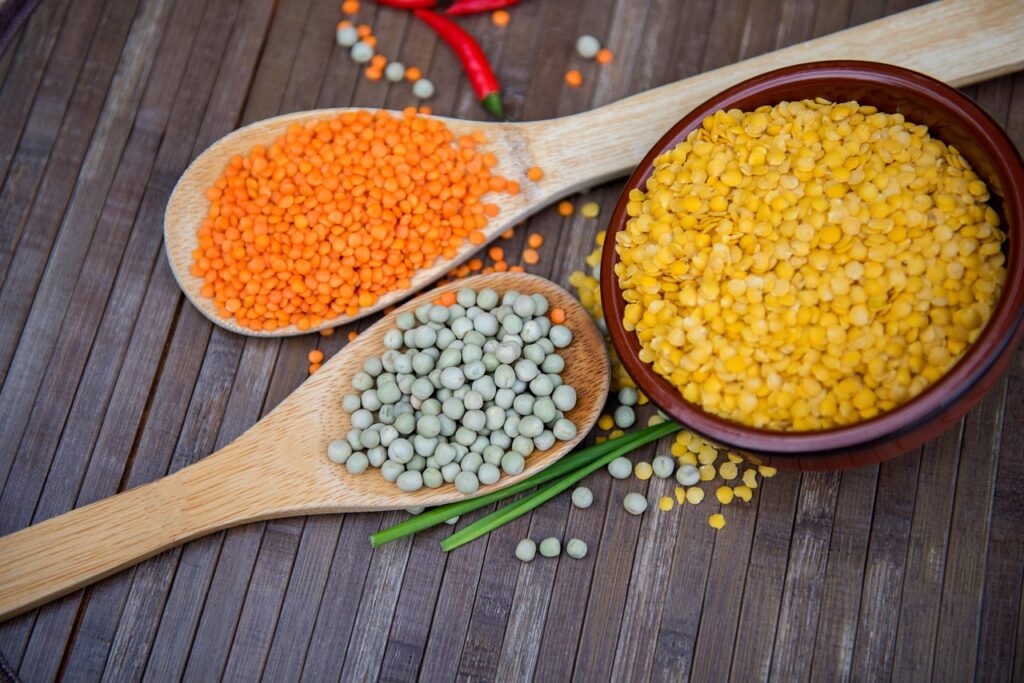
Macronutrient Profile
Legumes occupy a nutritionally unique position in the plant kingdom — they are simultaneously high in both protein and complex carbohydrates, while being genuinely low in fat (with the notable exception of soybeans and peanuts).
Protein — The Plant Protein Powerhouse
Legumes provide 18–36 g of protein per 100 g of dried weight — more than any other plant food group. This rivals the protein content of many meats on a per-calorie basis. Most legumes (except soybeans) are limiting in methionine, an essential amino acid — which is why the classic food pairing of legumes with cereals (rice and dal, beans and corn tortillas, hummus on bread) is found in virtually every traditional food culture. Together, they form a complete amino acid profile.
“Soybeans are the only plant food that provides all nine essential amino acids in sufficient amounts without combining with other foods — making them nutritionally equivalent to animal protein.”
Carbohydrates & Fibre — The Slow-Release Advantage
Legumes contain 55–65 g of carbohydrate per 100 g raw, but unlike refined grains, the carbohydrates in legumes are primarily resistant starch and oligosaccharides that digest slowly, producing a low glycaemic index (GI) of 20–40 for most varieties. This makes legumes one of the best foods for blood sugar management. Their fibre content of 8–25 g per 100 g raw feeds beneficial gut bacteria (prebiotics), reduces LDL cholesterol, and promotes satiety.
Fat — Lean with Exceptions
Most pulses contain just 0.5–2 g of fat per 100 g — essentially fat-free in practical terms. Soybeans (19.9 g) and peanuts (49.2 g) are the major exceptions, with predominantly heart-healthy unsaturated fatty acids. Soy fat includes significant linolenic acid (omega-3), while peanut fat is rich in oleic acid (omega-9), the same fat found in olive oil.
Macronutrient Comparison Table
| Legume / Pulse | Calories (kcal) | Protein (g) | Carbs (g) | Fat (g) | Fiber (g) |
|---|---|---|---|---|---|
| Red Lentils (raw) | 352 | 24.6 | 60.1 | 1.1 | 10.8 |
| Green Lentils (raw) | 352 | 25.8 | 60.1 | 1.1 | 10.7 |
| Brown Lentils (raw) | 352 | 24.6 | 60.1 | 1.1 | 10.7 |
| Black Lentils / Beluga (raw) | 348 | 24.0 | 60.1 | 1.1 | 10.9 |
| French Green Lentils / Puy (raw) | 352 | 25.8 | 60.0 | 1.1 | 10.7 |
| Chickpeas / Garbanzo Beans (raw) | 364 | 19.3 | 60.7 | 6.0 | 17.4 |
| Desi Chickpeas / Kala Chana (raw) | 360 | 20.5 | 59.6 | 5.3 | 16.8 |
| Black Beans (raw) | 341 | 21.6 | 62.4 | 1.4 | 15.5 |
| Kidney Beans, Red (raw) | 333 | 22.5 | 60.0 | 0.8 | 15.2 |
| Kidney Beans, White / Cannellini (raw) | 335 | 23.4 | 61.0 | 0.9 | 14.5 |
| Navy Beans (raw) | 337 | 22.3 | 60.8 | 1.5 | 15.8 |
| Pinto Beans (raw) | 347 | 21.4 | 62.5 | 1.2 | 15.5 |
| Adzuki Beans (raw) | 329 | 19.9 | 62.9 | 0.5 | 12.7 |
| Mung Beans (raw) | 347 | 23.9 | 62.6 | 1.2 | 16.3 |
| Black-eyed Peas / Cowpea (raw) | 336 | 23.5 | 60.0 | 1.3 | 15.7 |
| Fava Beans / Broad Beans (raw) | 341 | 26.1 | 58.3 | 1.5 | 25.0 |
| Lima Beans (raw) | 338 | 21.5 | 63.4 | 0.7 | 19.0 |
| Great Northern Beans (raw) | 335 | 21.9 | 62.0 | 1.1 | 12.4 |
| Cranberry / Borlotti Beans (raw) | 335 | 23.0 | 60.0 | 1.2 | 24.7 |
| Moth Beans (raw) | 343 | 22.9 | 61.5 | 1.6 | 9.9 |
| Yellow Split Peas (raw) | 348 | 24.6 | 61.5 | 1.0 | 8.3 |
| Green Split Peas (raw) | 348 | 24.6 | 61.5 | 1.0 | 8.3 |
| Whole Dried Green Peas (raw) | 341 | 22.1 | 61.8 | 1.1 | 13.1 |
| Black-eyed Peas (raw) | 336 | 23.5 | 60.0 | 1.3 | 15.7 |
| Soybeans (raw) | 446 | 36.5 | 30.2 | 19.9 | 9.3 |
| Edamame (raw, shelled) | 121 | 11.9 | 8.9 | 5.2 | 5.2 |
| Black Soybeans (raw) | 416 | 35.5 | 27.0 | 19.5 | 8.5 |
| Urad Dal / Black Gram (raw) | 347 | 25.2 | 59.0 | 1.6 | 18.3 |
| Urad Dal, Split White (raw) | 347 | 25.2 | 59.0 | 1.6 | 18.3 |
| Toor Dal / Pigeon Pea (raw) | 343 | 21.7 | 62.8 | 1.5 | 15.0 |
| Chana Dal / Split Chickpea (raw) | 364 | 20.1 | 60.8 | 5.5 | 16.5 |
| Moong Dal / Split Mung (raw) | 347 | 24.5 | 62.6 | 1.2 | 16.3 |
| Masoor Dal / Red Split Lentil (raw) | 352 | 24.6 | 60.1 | 1.1 | 10.8 |
| Lupin Beans (raw) | 371 | 36.2 | 40.4 | 9.7 | 18.9 |
| Peanuts / Groundnuts (raw) | 567 | 25.8 | 16.1 | 49.2 | 8.5 |
| Legume / Pulse | Serving Size | Calories (kcal) | Protein (g) | Carbs (g) | Fat (g) | Fiber (g) |
|---|---|---|---|---|---|---|
| Red Lentils (raw) | ¼ cup (~45g) | 158 | 11.1 | 27.0 | 0.5 | 4.9 |
| Green Lentils (raw) | ¼ cup (~45g) | 158 | 11.6 | 27.0 | 0.5 | 4.8 |
| Brown Lentils (raw) | ¼ cup (~45g) | 158 | 11.1 | 27.0 | 0.5 | 4.8 |
| Black Lentils / Beluga (raw) | ¼ cup (~45g) | 157 | 10.8 | 27.0 | 0.5 | 4.9 |
| French Green Lentils / Puy (raw) | ¼ cup (~45g) | 158 | 11.6 | 27.0 | 0.5 | 4.8 |
| Chickpeas / Garbanzo Beans (raw) | ¼ cup (~50g) | 182 | 9.7 | 30.4 | 3.0 | 8.7 |
| Desi Chickpeas / Kala Chana (raw) | ¼ cup (~50g) | 180 | 10.2 | 29.8 | 2.6 | 8.4 |
| Black Beans (raw) | ¼ cup (~50g) | 170 | 10.8 | 31.2 | 0.7 | 7.8 |
| Kidney Beans, Red (raw) | ¼ cup (~50g) | 166 | 11.2 | 30.0 | 0.4 | 7.6 |
| Kidney Beans, White / Cannellini (raw) | ¼ cup (~50g) | 168 | 11.7 | 30.5 | 0.5 | 7.2 |
| Navy Beans (raw) | ¼ cup (~50g) | 168 | 11.2 | 30.4 | 0.8 | 7.9 |
| Pinto Beans (raw) | ¼ cup (~50g) | 174 | 10.7 | 31.2 | 0.6 | 7.8 |
| Adzuki Beans (raw) | ¼ cup (~50g) | 164 | 9.9 | 31.4 | 0.2 | 6.3 |
| Mung Beans (raw) | ¼ cup (~50g) | 174 | 11.9 | 31.3 | 0.6 | 8.2 |
| Black-eyed Peas / Cowpea (raw) | ¼ cup (~50g) | 168 | 11.8 | 30.0 | 0.7 | 7.8 |
| Fava Beans / Broad Beans (raw) | ¼ cup (~50g) | 170 | 13.1 | 29.1 | 0.8 | 12.5 |
| Lima Beans (raw) | ¼ cup (~50g) | 169 | 10.8 | 31.7 | 0.3 | 9.5 |
| Great Northern Beans (raw) | ¼ cup (~50g) | 168 | 10.9 | 31.0 | 0.6 | 6.2 |
| Cranberry / Borlotti Beans (raw) | ¼ cup (~50g) | 168 | 11.5 | 30.0 | 0.6 | 12.3 |
| Moth Beans (raw) | ¼ cup (~50g) | 172 | 11.4 | 30.8 | 0.8 | 5.0 |
| Yellow Split Peas (raw) | ¼ cup (~50g) | 174 | 12.3 | 30.8 | 0.5 | 4.2 |
| Green Split Peas (raw) | ¼ cup (~50g) | 174 | 12.3 | 30.8 | 0.5 | 4.2 |
| Whole Dried Green Peas (raw) | ¼ cup (~50g) | 170 | 11.1 | 30.9 | 0.6 | 6.5 |
| Black-eyed Peas (raw) | ¼ cup (~50g) | 168 | 11.8 | 30.0 | 0.7 | 7.8 |
| Soybeans (raw) | 3 tbsp (~45g) | 201 | 16.4 | 13.6 | 9.0 | 4.2 |
| Edamame (raw, shelled) | 1 cup (~155g) | 188 | 18.4 | 13.8 | 8.1 | 8.1 |
| Black Soybeans (raw) | 3 tbsp (~45g) | 187 | 16.0 | 12.2 | 8.8 | 3.8 |
| Urad Dal / Black Gram (raw) | 3 tbsp (~45g) | 156 | 11.3 | 26.6 | 0.7 | 8.2 |
| Urad Dal, Split White (raw) | 3 tbsp (~45g) | 156 | 11.3 | 26.6 | 0.7 | 8.2 |
| Toor Dal / Pigeon Pea (raw) | ¼ cup (~50g) | 172 | 10.8 | 31.4 | 0.8 | 7.5 |
| Chana Dal / Split Chickpea (raw) | ¼ cup (~50g) | 182 | 10.1 | 30.4 | 2.8 | 8.2 |
| Moong Dal / Split Mung (raw) | 3 tbsp (~45g) | 156 | 11.0 | 28.2 | 0.5 | 7.3 |
| Masoor Dal / Red Split Lentil (raw) | 3 tbsp (~45g) | 158 | 11.1 | 27.0 | 0.5 | 4.9 |
| Lupin Beans (raw) | ¼ cup (~50g) | 186 | 18.1 | 20.2 | 4.8 | 9.4 |
| Peanuts / Groundnuts (raw) | ~28g / 1 oz | 170 | 7.7 | 4.8 | 14.8 | 2.5 |
Vitamin Content — A Deep Dive
Legumes are exceptional sources of B-complex vitamins, especially folate (B9), thiamin (B1), and niacin (B3). They contribute meaningfully to meeting daily requirements with just a single serving.
Folate (Vitamin B9) — The Standout Vitamin
Folate is arguably the most important micronutrient in legumes. A 100 g serving of black-eyed peas, mung beans, adzuki beans, or pinto beans can provide 500–633 µg of folate — meeting or exceeding the adult RDA of 400 µg in a single food. Folate is critical for DNA synthesis, cell division, and prevention of neural tube defects during pregnancy. No other food category rivals legumes as a folate source.
- Black-eyed Peas — (Folate) 633 µg / 100g – 158% DRI
- Mung Beans — (Folate) 625 µg / 100g – 156% DRI
- Adzuki Beans — (Folate) 622 µg / 100g – 155% DRI
- Chickpeas — (Folate) 557 µg / 100g – 139% DRI
- Red Lentils — (Folate) 479 µg / 100g – 120% DRI
- Split Peas — (Folate) 274 µg / 100g – 69% DRI
Thiamin (Vitamin B1)
Thiamin is essential for converting carbohydrates into energy and supporting nerve function. Black beans (0.90 mg), lentils (0.87 mg), and soybeans (0.87 mg) top the legume charts, providing over 70% of the adult RDA (1.1–1.2 mg) in 100 g. Thiamin deficiency (beriberi) was historically common in populations subsisting on polished white rice alone — adding lentils or dal dramatically reverses this risk.
Niacin (Vitamin B3)
Peanuts are the clear outlier here — providing a remarkable 12.07 mg of niacin per 100 g (75–85% of daily RDA). Split peas (3.11 mg) and fava beans (2.82 mg) also contribute meaningfully. Niacin supports energy metabolism, DNA repair, and is linked to reduced cardiovascular risk at higher intakes.
Riboflavin (Vitamin B2)
Soybeans are the legume leader for riboflavin at 0.87 mg/100g — nearly twice any other legume. Fava beans (0.33 mg), black-eyed peas (0.26 mg), and urad dal (0.25 mg) also rank well. Riboflavin is critical for energy production and antioxidant recycling (it regenerates glutathione).
Vitamin K
Soybeans are by far the best legume source of vitamin K at 47 µg/100g, followed by edamame (26 µg) and split peas (~25 µg). Vitamin K is essential for blood clotting and bone mineralisation. Those on warfarin (a blood thinner) should note that soybeans have a notable vitamin K content.
Vitamin E
Peanuts dominate again with 8.33 mg of vitamin E per 100 g — more than half the daily requirement in a small handful. Soybeans (1.95 mg) and lupin beans (1.76 mg) follow. Vitamin E is a fat-soluble antioxidant that protects cell membranes from oxidative damage.
Vitamin C
Fresh legumes (edamame: 9.7 mg, chickpeas: 4.0 mg, pinto beans: 6.3 mg) provide modest vitamin C, but this largely disappears on drying and cooking. Notably, sprouting dramatically increases vitamin C — mung bean sprouts can contain 10–15 mg/100g, compared to near-zero in the dried bean. Sprouting is therefore an excellent strategy for improving the vitamin profile of legumes.
Pair iron-rich legumes with vitamin C sources at the same meal. The ascorbic acid dramatically increases non-haem iron absorption (by 2–3×). Try lentil soup with a squeeze of lemon, or dal with a fresh tomato chutney.
Vitamin Content Table
| Legume / Pulse | B1 Thiamin (mg) | B2 Riboflavin (mg) | B3 Niacin (mg) | B6 (mg) | B9 Folate (µg) | Vitamin C (mg) | Vitamin K (µg) | Vitamin E (mg) | Notable Remarks |
|---|---|---|---|---|---|---|---|---|---|
| Red Lentils (raw) | 0.87 | 0.21 | 2.60 | 0.54 | 479.00 | 4.40 | 5.00 | 0.49 | Excellent folate & iron; high zinc vs other lentils |
| Green Lentils (raw) | 0.87 | 0.21 | 2.60 | 0.54 | 479.00 | 4.40 | 5.00 | 0.49 | Nutritionally near-identical to red lentils; folate standout |
| Brown Lentils (raw) | 0.87 | 0.21 | 2.60 | 0.54 | 479.00 | 4.40 | 5.00 | 0.49 | All lentil varieties share similar micro profile; strong B1 |
| Black Lentils / Beluga (raw) | 0.84 | 0.20 | 2.50 | 0.52 | 460.00 | 4.00 | 4.80 | 0.47 | Rich in anthocyanins; similar micros to other lentils |
| French Green Lentils / Puy (raw) | 0.87 | 0.21 | 2.60 | 0.54 | 479.00 | 4.40 | 5.00 | 0.49 | Same micro profile as green lentils; firm texture retained on cooking |
| Chickpeas / Garbanzo Beans (raw) | 0.48 | 0.21 | 1.54 | 0.54 | 557.00 | 4.00 | 9.00 | 0.82 | Highest folate among common legumes; notable calcium; good selenium |
| Desi Chickpeas / Kala Chana (raw) | 0.48 | 0.21 | 1.54 | 0.54 | 557.00 | 4.00 | 9.00 | 0.82 | Higher Ca & Fe than kabuli; dark coat = extra antioxidants |
| Black Beans (raw) | 0.90 | 0.19 | 2.11 | 0.32 | 444.00 | 0.00 | 5.60 | 0.87 | Exceptional potassium & magnesium; rich in anthocyanins |
| Kidney Beans, Red (raw) | 0.53 | 0.22 | 2.11 | 0.40 | 394.00 | 4.50 | 8.40 | 0.21 | High calcium; substantial potassium; cook thoroughly—lectins |
| Kidney Beans, White/Cannellini (raw) | 0.53 | 0.22 | 2.11 | 0.40 | 388.00 | 4.50 | 8.40 | 0.21 | Highest calcium among common beans; very high iron & potassium |
| Navy Beans (raw) | 0.77 | 0.13 | 1.99 | 0.42 | 364.00 | 4.30 | 5.00 | 0.22 | Best selenium source among beans; high calcium; strong B1 |
| Pinto Beans (raw) | 0.71 | 0.21 | 1.68 | 0.47 | 525.00 | 6.30 | 5.60 | 0.94 | Highest selenium of common beans; excellent folate; good manganese |
| Adzuki Beans (raw) | 0.46 | 0.22 | 2.37 | 0.35 | 622.00 | 0.00 | 1.70 | 0.50 | Highest folate of any common bean; excellent zinc; popular in Asian cuisine |
| Mung Beans (raw) | 0.62 | 0.23 | 2.25 | 0.38 | 625.00 | 4.80 | 9.00 | 0.51 | Excellent folate; sprouts raise vitamin C significantly; very digestible |
| Black-eyed Peas / Cowpea (raw) | 0.85 | 0.26 | 2.09 | 0.36 | 633.00 | 1.50 | 5.10 | 0.39 | Highest folate in dataset; strong B2 & iron; staple in Indian/African cooking |
| Fava Beans / Broad Beans (raw) | 0.60 | 0.33 | 2.82 | 0.37 | 423.00 | 1.40 | 9.00 | 0.05 | High niacin & riboflavin; AVOID in G6PD deficiency (favism risk) |
| Lima Beans (raw) | 0.51 | 0.21 | 1.54 | 0.51 | 395.00 | 0.00 | 6.70 | 0.72 | Exceptional potassium & magnesium; raw contain linamarin—always cook |
| Great Northern Beans (raw) | 0.68 | 0.14 | 2.00 | 0.45 | 370.00 | 4.00 | 5.00 | 0.22 | High calcium; good potassium & magnesium; mild flavor, great for soups |
| Cranberry / Borlotti Beans (raw) | 0.57 | 0.22 | 2.20 | 0.40 | 604.00 | 0.00 | 5.90 | 0.60 | Very high folate; moderate iron; speckled pattern fades on cooking |
| Moth Beans (raw) | 0.54 | 0.18 | 2.10 | 0.30 | 518.00 | 3.00 | 7.20 | 0.40 | Very high iron & calcium among lesser-known beans; popular in Rajasthan |
| Yellow Split Peas (raw) | 0.73 | 0.17 | 3.11 | 0.17 | 274.00 | 1.80 | 24.80 | 0.10 | Good niacin & vitamin K; quick-cooking without soaking |
| Green Split Peas (raw) | 0.72 | 0.16 | 3.01 | 0.16 | 274.00 | 1.80 | 24.80 | 0.10 | Near-identical to yellow split peas; contains chlorophyll |
| Whole Dried Green Peas (raw) | 0.73 | 0.17 | 3.11 | 0.17 | 274.00 | 1.80 | 24.80 | 0.10 | Outer seed coat adds extra fiber & polyphenols vs split |
| Black-eyed Peas (raw) | 0.85 | 0.26 | 2.09 | 0.36 | 633.00 | 1.50 | 5.10 | 0.39 | Same as Cowpea entry (Vigna unguiculata); see above |
| Soybeans (raw) | 0.87 | 0.87 | 1.62 | 0.38 | 375.00 | 6.00 | 47.00 | 1.95 | Nutritional powerhouse—highest Ca, Mg, Fe, Zn, Se; complete amino acids; rich in isoflavones |
| Edamame (raw, shelled) | 0.27 | 0.16 | 1.06 | 0.14 | 303.00 | 9.70 | 26.00 | 0.68 | Fresh soybean; good vitamin C & K; convenient snack form |
| Black Soybeans (raw) | 0.87 | 0.87 | 1.62 | 0.38 | 375.00 | 6.00 | 47.00 | 1.95 | Same nutrients as yellow soy; black coat adds anthocyanins |
| Urad Dal / Black Gram (raw) | 0.27 | 0.25 | 1.45 | 0.28 | 216.00 | 0.00 | 1.50 | 0.37 | Exceptional magnesium; high iron & calcium; South Indian cooking staple |
| Urad Dal, Split White (raw) | 0.27 | 0.25 | 1.45 | 0.28 | 216.00 | 0.00 | 1.50 | 0.37 | Dehusked urad—same nutrients; husk removal reduces fiber slightly |
| Toor Dal / Pigeon Pea (raw) | 0.64 | 0.19 | 2.97 | 0.05 | 456.00 | 0.00 | 0.00 | 0.20 | Very high potassium; good folate & niacin; staple dal across India |
| Chana Dal / Split Chickpea (raw) | 0.48 | 0.21 | 1.54 | 0.54 | 557.00 | 4.00 | 9.00 | 0.82 | Same as whole chickpea; split form absorbs water faster; lower GI |
| Moong Dal / Split Mung (raw) | 0.62 | 0.23 | 2.25 | 0.38 | 625.00 | 4.80 | 9.00 | 0.51 | Very digestible; often given to convalescents; same micros as whole mung |
| Masoor Dal / Red Split Lentil (raw) | 0.87 | 0.21 | 2.60 | 0.54 | 479.00 | 4.40 | 5.00 | 0.49 | Quick-cooking (no coat); excellent iron & folate; most popular Indian dal |
| Lupin Beans (raw) | 0.59 | 0.28 | 2.21 | 0.27 | 355.00 | 4.80 | 0.00 | 1.76 | Rising gluten-free ingredient; avoid if peanut allergy (cross-reactivity) |
| Peanuts / Groundnuts (raw) | 0.64 | 0.14 | 12.07 | 0.35 | 240.00 | 0.00 | 0.00 | 8.33 | Highest niacin & vitamin E in dataset; technically a legume, used as a nut |
mg = milligrams · µg = micrograms | B9 Folate & Vit K in µg; all others in mg
Mineral Content — A Deep Dive
Legumes are among the richest plant sources of iron, magnesium, phosphorus, potassium, zinc, and manganese. The challenge is bioavailability — proper preparation dramatically improves how much your body actually absorbs.
Iron — Fighting Anaemia Naturally
Iron is where legumes truly shine for plant-based eaters. Soybeans lead with an extraordinary 15.7 mg of iron per 100 g (196% of the male RDA), followed by white kidney beans (10.4 mg), moth beans (10.4 mg), and lentils (7.5 mg). This non-haem iron is less bioavailable than haem iron from meat, but pairing with vitamin C and avoiding tea/coffee within an hour of eating can increase absorption substantially.
- Soybeans — 15.7 mg
- White Kidney Beans — 10.4 mg
- Moth Beans — 10.4 mg
- Black Beans — 8.7 mg
- Red Kidney Beans — 8.2 mg
- Lentils (all) — 7.5 mg
Calcium — The Dairy-Free Bone Builder
Soybeans provide 277 mg of calcium per 100 g — approaching the 300 mg found in a glass of milk, making them a genuine dairy alternative for bone health. White kidney beans (240 mg), moth beans (202 mg), and lupin beans (176 mg) are also impressive sources. For vegans concerned about calcium, legumes — especially soybeans and white beans — should be daily staples.
- Soybeans — 277 mg
- White Kidney Beans — 240 mg
- Moth Beans — 202 mg
- Great Northern Beans — 175 mg
- Lupin Beans — 176 mg
- Urad Dal — 138 mg
Magnesium — The Underrated Mineral
Magnesium participates in over 300 enzymatic reactions and is critical for muscle function, blood pressure regulation, and insulin signalling. Urad dal leads at 267 mg/100g, followed by soybeans (280 mg), lima beans (224 mg), and black beans (171 mg). A 100 g serving of urad dal covers 65–85% of the adult daily requirement. Magnesium deficiency is one of the most common nutritional shortfalls in modern diets; legumes are among the best practical solutions.
Potassium — The Heart-Protective Mineral
Potassium counterbalances sodium’s effects on blood pressure. Legumes are extraordinary potassium sources: soybeans and lima beans provide over 1,700 mg per 100 g raw — half the daily Adequate Intake of 2,600–3,400 mg in a single food. Black beans, kidney beans, and toor dal also provide 1,300–1,500 mg/100g. This is why DASH diet (Dietary Approaches to Stop Hypertension) studies consistently show legume consumption reduces blood pressure.
Zinc — Immune & Hormone Health
Zinc supports immune function, wound healing, testosterone synthesis, and taste perception. Soybeans (4.89 mg), adzuki beans (5.04 mg), and lentils (4.78 mg) are standout sources. The phytate content of legumes does reduce zinc absorption — but fermentation (tempeh, idli/dosa batters) and sprouting significantly improve bioavailability.
Selenium — The Antioxidant Trace Mineral
Selenium is often overlooked but vital for thyroid function and antioxidant defence (as part of glutathione peroxidase). Pinto beans (27.9 mg/100g) are by far the richest legume source, followed by navy beans (12.4 mg) and black-eyed peas (9.3 mg). Selenium content varies with soil quality — legumes grown in selenium-rich soils can provide substantially more.
Manganese & Copper
Manganese is essential for bone formation and antioxidant enzymes; copper for iron metabolism and connective tissue. Chickpeas (2.20 mg Mn), soybeans (2.52 mg Mn), and adzuki beans (1.73 mg Mn) are leading sources. For copper, soybeans (1.66 mg) and adzuki beans (1.09 mg) stand out. These trace minerals are rarely discussed but consistently well-supplied by legume-rich diets.
Mineral Content Table
| Legume / Pulse | Iron Fe (mg) | Calcium Ca (mg) | Magnesium Mg (mg) | Phosphorus P (mg) | Potassium K (mg) | Zinc Zn (mg) | Manganese Mn (mg) | Copper Cu (mg) | Selenium Se (µg) | Notable Remarks |
|---|---|---|---|---|---|---|---|---|---|---|
| Red Lentils (raw) | 7.54 | 56.00 | 122.00 | 451.00 | 955.00 | 4.78 | 1.39 | 0.75 | 0.10 | Excellent folate & iron; high zinc vs other lentils |
| Green Lentils (raw) | 7.54 | 56.00 | 122.00 | 451.00 | 955.00 | 4.78 | 1.39 | 0.75 | 0.10 | Nutritionally near-identical to red lentils; folate standout |
| Brown Lentils (raw) | 7.54 | 56.00 | 122.00 | 451.00 | 955.00 | 4.78 | 1.39 | 0.75 | 0.10 | All lentil varieties share similar micro profile; strong B1 |
| Black Lentils / Beluga (raw) | 7.20 | 54.00 | 118.00 | 440.00 | 940.00 | 4.60 | 1.35 | 0.72 | 0.10 | Rich in anthocyanins; similar micros to other lentils |
| French Green Lentils / Puy (raw) | 7.54 | 56.00 | 122.00 | 451.00 | 955.00 | 4.78 | 1.39 | 0.75 | 0.10 | Same micro profile as green lentils; firm texture retained on cooking |
| Chickpeas / Garbanzo Beans (raw) | 6.24 | 105.00 | 115.00 | 366.00 | 875.00 | 3.43 | 2.20 | 0.85 | 8.20 | Highest folate among common legumes; notable calcium; good selenium |
| Desi Chickpeas / Kala Chana (raw) | 6.50 | 138.00 | 119.00 | 371.00 | 846.00 | 3.53 | 2.25 | 0.87 | 8.00 | Higher Ca & Fe than kabuli; dark coat = extra antioxidants |
| Black Beans (raw) | 8.70 | 123.00 | 171.00 | 352.00 | 1483.00 | 3.65 | 1.10 | 0.84 | 6.10 | Exceptional potassium & magnesium; rich in anthocyanins |
| Kidney Beans, Red (raw) | 8.20 | 143.00 | 140.00 | 407.00 | 1406.00 | 2.79 | 1.02 | 0.96 | 3.20 | High calcium; substantial potassium; cook thoroughly—lectins |
| Kidney Beans, White/Cannellini (raw) | 10.40 | 240.00 | 190.00 | 500.00 | 1795.00 | 3.67 | 1.80 | 0.98 | 2.50 | Highest calcium among common beans; very high iron & potassium |
| Navy Beans (raw) | 5.49 | 147.00 | 175.00 | 407.00 | 1185.00 | 3.65 | 1.34 | 0.83 | 12.40 | Best selenium source among beans; high calcium; strong B1 |
| Pinto Beans (raw) | 5.07 | 113.00 | 176.00 | 411.00 | 1393.00 | 2.28 | 1.15 | 0.89 | 27.90 | Highest selenium of common beans; excellent folate; good manganese |
| Adzuki Beans (raw) | 4.98 | 66.00 | 127.00 | 381.00 | 1254.00 | 5.04 | 1.73 | 1.09 | 3.10 | Highest folate of any common bean; excellent zinc; popular in Asian cuisine |
| Mung Beans (raw) | 6.74 | 132.00 | 189.00 | 367.00 | 1246.00 | 2.68 | 1.04 | 0.94 | 8.20 | Excellent folate; sprouts raise vitamin C significantly; very digestible |
| Black-eyed Peas / Cowpea (raw) | 8.00 | 110.00 | 184.00 | 424.00 | 1112.00 | 3.37 | 1.56 | 0.83 | 9.30 | Highest folate in dataset; strong B2 & iron; staple in Indian/African cooking |
| Fava Beans / Broad Beans (raw) | 6.70 | 103.00 | 192.00 | 421.00 | 1062.00 | 3.14 | 1.63 | 0.82 | 8.50 | High niacin & riboflavin; AVOID in G6PD deficiency (favism risk) |
| Lima Beans (raw) | 7.51 | 81.00 | 224.00 | 385.00 | 1724.00 | 2.83 | 1.65 | 0.73 | 6.00 | Exceptional potassium & magnesium; raw contain linamarin—always cook |
| Great Northern Beans (raw) | 5.10 | 175.00 | 189.00 | 424.00 | 1387.00 | 3.32 | 1.41 | 0.89 | 5.30 | High calcium; good potassium & magnesium; mild flavor, great for soups |
| Cranberry / Borlotti Beans (raw) | 5.78 | 138.00 | 152.00 | 415.00 | 1332.00 | 2.79 | 1.10 | 0.93 | 4.50 | Very high folate; moderate iron; speckled pattern fades on cooking |
| Moth Beans (raw) | 10.40 | 202.00 | 214.00 | 480.00 | 1024.00 | 2.68 | 1.43 | 0.91 | 5.20 | Very high iron & calcium among lesser-known beans; popular in Rajasthan |
| Yellow Split Peas (raw) | 4.43 | 70.00 | 115.00 | 366.00 | 981.00 | 3.28 | 0.98 | 0.66 | 1.90 | Good niacin & vitamin K; quick-cooking without soaking |
| Green Split Peas (raw) | 4.43 | 67.00 | 115.00 | 366.00 | 981.00 | 3.28 | 0.98 | 0.66 | 1.90 | Near-identical to yellow split peas; contains chlorophyll |
| Whole Dried Green Peas (raw) | 4.43 | 70.00 | 115.00 | 366.00 | 981.00 | 3.28 | 0.98 | 0.66 | 1.90 | Outer seed coat adds extra fiber & polyphenols vs split |
| Black-eyed Peas (raw) | 8.00 | 110.00 | 184.00 | 424.00 | 1112.00 | 3.37 | 1.56 | 0.83 | 9.30 | Same as Cowpea entry (Vigna unguiculata); see above |
| Soybeans (raw) | 15.70 | 277.00 | 280.00 | 704.00 | 1797.00 | 4.89 | 2.52 | 1.66 | 17.80 | Nutritional powerhouse—highest Ca, Mg, Fe, Zn, Se; complete amino acids; rich in isoflavones |
| Edamame (raw, shelled) | 3.55 | 63.00 | 65.00 | 169.00 | 436.00 | 1.37 | 1.02 | 0.49 | 1.50 | Fresh soybean; good vitamin C & K; convenient snack form |
| Black Soybeans (raw) | 15.70 | 277.00 | 280.00 | 704.00 | 1797.00 | 4.89 | 2.52 | 1.66 | 17.80 | Same nutrients as yellow soy; black coat adds anthocyanins |
| Urad Dal / Black Gram (raw) | 7.57 | 138.00 | 267.00 | 379.00 | 983.00 | 3.35 | 1.56 | 1.07 | 6.00 | Exceptional magnesium; high iron & calcium; South Indian cooking staple |
| Urad Dal, Split White (raw) | 7.57 | 138.00 | 267.00 | 379.00 | 983.00 | 3.35 | 1.56 | 1.07 | 6.00 | Dehusked urad—same nutrients; husk removal reduces fiber slightly |
| Toor Dal / Pigeon Pea (raw) | 5.23 | 130.00 | 183.00 | 367.00 | 1392.00 | 2.76 | 1.79 | 1.06 | 8.50 | Very high potassium; good folate & niacin; staple dal across India |
| Chana Dal / Split Chickpea (raw) | 6.24 | 105.00 | 115.00 | 366.00 | 875.00 | 3.43 | 2.20 | 0.85 | 8.20 | Same as whole chickpea; split form absorbs water faster; lower GI |
| Moong Dal / Split Mung (raw) | 6.74 | 132.00 | 189.00 | 367.00 | 1246.00 | 2.68 | 1.04 | 0.94 | 8.20 | Very digestible; often given to convalescents; same micros as whole mung |
| Masoor Dal / Red Split Lentil (raw) | 7.54 | 56.00 | 122.00 | 451.00 | 955.00 | 4.78 | 1.39 | 0.75 | 0.10 | Quick-cooking (no coat); excellent iron & folate; most popular Indian dal |
| Lupin Beans (raw) | 4.36 | 176.00 | 198.00 | 440.00 | 1013.00 | 4.75 | 2.14 | 0.87 | 6.00 | Rising gluten-free ingredient; avoid if peanut allergy (cross-reactivity) |
| Peanuts / Groundnuts (raw) | 4.58 | 92.00 | 168.00 | 376.00 | 705.00 | 3.27 | 1.93 | 1.14 | 7.20 | Highest niacin & vitamin E in dataset; technically a legume, used as a nut |
Health Benefits & The Science Behind Them
1. Cardiovascular Health
Multiple large meta-analyses (including a landmark 2014 JAMA Internal Medicine study) found that eating legumes 4 times per week reduced coronary heart disease risk by 14% compared to less than once a week. The mechanisms are multiple: soluble fibre reduces LDL cholesterol, potassium lowers blood pressure, folate reduces homocysteine (a cardiovascular risk marker), and plant sterols compete with cholesterol absorption in the gut.
2. Type 2 Diabetes & Blood Sugar Management
With a glycaemic index of 20–40 and high resistant starch content, legumes produce a blunted blood sugar response compared to bread, rice, or potatoes. A 2012 Cochrane Review found that legume consumption significantly reduced HbA1c (a long-term blood sugar marker) in people with type 2 diabetes. The resistant starch in legumes also produces second meal effect — consuming them at lunch measurably reduces blood glucose response to dinner, even hours later.
3. Gut Microbiome & Prebiotic Fibre
The oligosaccharides and resistant starch in legumes are among the most potent prebiotic compounds known. They selectively feed beneficial bacteria — particularly Bifidobacterium and Lactobacillus species — and increase the production of short-chain fatty acids (SCFAs) like butyrate, which nourishes colon cells and reduces inflammation. This is why traditional societies consuming legumes daily show dramatically lower rates of colorectal cancer.
4. Weight Management & Satiety
Legumes are a rare combination: high protein + high fibre + relatively low calorie density (compared to meat or nuts). Both protein and fibre independently stimulate satiety hormones (GLP-1, CCK, PYY) and suppress hunger. A systematic review in Obesity journal found that legume consumption increased feelings of fullness by 31% compared to control meals.
5. Cancer Risk Reduction
Observational data consistently links legume consumption with reduced risk of colorectal, breast, and prostate cancers. The likely mechanisms include butyrate production (inhibits cancer cell proliferation), isoflavones in soy (oestrogen-receptor modulation), and the general anti-inflammatory effect of fibre. Soybeans’ isoflavones (genistein, daidzein) have been among the most extensively studied phytochemicals in cancer epidemiology.
6. Bone Health
Beyond calcium, legumes supply boron, magnesium, and vitamin K — all critical for bone mineral density. Studies on soy isoflavones suggest they may reduce bone resorption in postmenopausal women. A diet rich in legumes, particularly soybeans, is associated with higher bone density in Asian populations with high lifelong soy consumption.
Antinutrients & How to Reduce Them
Legumes contain naturally occurring compounds that can interfere with nutrient absorption or cause digestive discomfort in some people. Understanding these — and how to address them — unlocks the full nutritional potential of legumes.
Common Antinutrients in Legumes & Evidence-Based Reduction Methods
| Antinutrient | Effect | Most Affected Legumes | Best Reduction Method |
|---|---|---|---|
| Phytic Acid (Phytates) | Binds iron, zinc, calcium — reduces absorption | All legumes | Soaking 8–12h + discard water; sprouting; fermentation |
| Lectins | Gut irritation; may cause nausea if raw | Red kidney beans (highest) | Boiling vigorously for 10+ min; pressure cooking |
| Tannins | Reduce protein & iron absorption; bitter taste | Lentils, chickpeas, red beans | Soaking; dehulling; cooking |
| Trypsin Inhibitors | Reduce protein digestibility | Soybeans, kidney beans | Thorough cooking; heat-stable, so boiling is essential |
| Oligosaccharides (Raffinose, Stachyose) | Fermented in colon → gas & bloating | All legumes, especially lentils & beans | Soaking + discarding water; slow introduction; digestive enzymes (Beano) |
| Oxalates | Bind calcium; kidney stone risk at excess | Soy, peanuts | Boiling in water reduces ~35–45% oxalate |
| Favism Factor (Vicine) | Haemolytic anaemia in G6PD-deficient individuals | Fava / Broad Beans only | Avoid entirely if G6PD deficiency is diagnosed |
| Linamarin | Releases cyanide — toxic raw | Lima Beans (raw) | Never eat raw; boiling for 15+ min fully eliminates |
Antinutrients are not a reason to avoid legumes — they are a reason to prepare them properly. Soaking, discarding soak water, and thorough cooking eliminates 80–95% of the problematic compounds. The nutritional benefits of legumes far outweigh any residual antinutrient effects in properly prepared food.
Cooking Methods & Bioavailability Tips
Soaking
Soaking dried legumes for 8–12 hours in cold water (or 2–4 hours in hot water) serves multiple functions: it reduces cooking time, softens the outer seed coat, and leaches out water-soluble antinutrients like phytates, tannins, and raffinose oligosaccharides. Always discard the soak water — do not cook in it. Research shows soaking reduces phytic acid by 15–30% and oligosaccharides by up to 80%.
Pressure Cooking
Pressure cooking is the single most effective preparation method for legumes — it achieves the highest lectin and trypsin inhibitor denaturation, reduces cooking time by 60–70%, and retains most heat-stable vitamins and minerals. A pressure cooker is especially valuable for dense legumes like chickpeas, kidney beans, and black-eyed peas that require long cooking otherwise.
Sprouting
Sprouting — soaking then allowing germination for 24–72 hours — dramatically alters the nutritional profile. It increases vitamin C from near-zero to 10–20 mg/100g, reduces phytic acid by 20–50%, and partially pre-digests starch (lowering GI further). Mung bean and lentil sprouts are the most commonly consumed and nutritionally well-studied. Consume sprouts fresh or lightly cooked.
Fermentation
Traditional fermentation (as in idli, dosa, tempeh, natto, miso) is the most powerful method for improving legume nutrition. Microbial activity breaks down phytates (improving mineral absorption by 30–60%), partially pre-digests protein (improving digestibility to 85–90% — comparable to meat), produces B12 in some fermented forms, and generates beneficial probiotics. Tempeh and natto from soybeans are considered among the most bioavailable protein sources in the entire food kingdom.
Adding Acid & Aromatics
Adding a splash of lemon juice, tamarind, or tomatoes to cooked dal and beans serves two purposes: the acidity enhances iron absorption (vitamin C effect), and the low-pH environment slightly reduces remaining oligosaccharides. Traditional Indian dal cooking with lemon squeeze at the end is nutritionally optimal, not merely flavour tradition.
Head-to-Head Comparisons
Best Legume for Protein
Winner: Soybeans (36.5 g) & Lupin Beans (36.2 g). Both provide roughly the same protein as chicken breast on a dry weight basis. For typical Indian cooking, urad dal (25.2 g) and green lentils (25.8 g) lead among everyday dals.
Best Legume for Iron
Winner: Soybeans (15.7 mg) — almost double the male RDA in 100 g. For everyday accessible options, lentils (7.5 mg) remain the most practical daily iron source across the world.
Best Legume for Folate
Winner: Black-eyed Peas (633 µg) and Mung Beans (625 µg) — both exceeding the adult RDA in 100 g. Chickpeas (557 µg) and pinto beans (525 µg) follow closely.
Best Legume for Gut Health
Winner: Fava Beans for raw fibre (25 g/100g), but in practice lima beans (19 g) and urad dal (18.3 g) score high and are more widely consumed. All legumes are exceptional prebiotic fibre sources.
Best Legume for Diabetics
Winner: Lentils — they have the lowest GI (18–35), the highest ratio of resistant starch to total carbohydrate, and the second meal effect is best documented in lentil studies. Mung beans are equally excellent.
Best Legume for Vegetarians / Vegans
Winner: Soybeans — the only plant food with a complete amino acid profile, high iron, high calcium, and the fat profile of heart-healthy oils. For daily practical use, a combination of lentils + chickpeas + mung across the week covers all micronutrient bases comprehensively.
Who Benefits Most?
🤰Pregnant Women
Folate requirements double during pregnancy to 600 µg/day. Legumes are the richest dietary source. Iron needs also increase — lentils and black-eyed peas address both simultaneously.
Best: Lentils, Chickpeas, Black-eyed Peas
🌱Vegans & Vegetarians
Legumes provide the protein, iron, zinc, and calcium that are most at risk on plant-only diets. Daily legume consumption is non-negotiable for nutritional adequacy.
🏋️Athletes & Active People
High protein for muscle repair, potassium & magnesium for electrolyte balance and muscle function, and B-vitamins for energy metabolism.
🩺Type 2 Diabetics
Low GI, high fibre, and resistant starch make legumes the ideal carbohydrate source for blood sugar management. Proven to reduce HbA1c.
❤️Heart Health
Soluble fibre lowers LDL, potassium reduces blood pressure, folate reduces homocysteine. All legumes benefit — 4 servings/week cuts CHD risk ~14%.
🦴Bone Health / Osteoporosis
Calcium, magnesium, vitamin K, and soy isoflavones all support bone density. Particularly relevant for postmenopausal women.
Frequently Asked Questions (FAQs)
1. How much legumes should I eat per day?
The WHO, Dietary Guidelines for Americans, and most national dietary guidelines recommend ½ cup of cooked legumes daily (approximately 100 g cooked / 45–50 g dry), or at least 3–5 servings per week. Most traditional South Asian, Mediterranean, and Latin American diets already exceed this recommendation and consistently show superior health outcomes.
2. Do legumes cause bloating and gas?
The flatulence associated with legumes is caused by oligosaccharides (raffinose, stachyose) that human enzymes cannot digest — they reach the colon intact where bacteria ferment them. This side effect reduces significantly with: (1) regular consumption — the gut microbiome adapts over 2–3 weeks; (2) soaking and discarding soak water; (3) pressure cooking; (4) starting with more digestible varieties like red lentils, moong dal, and split peas before progressing to whole beans.
3. Are canned legumes nutritionally comparable to dried and cooked?
Broadly yes — canned legumes retain 85–95% of the mineral content and fibre of home-cooked. The main differences are: (1) sodium can be very high in salted canned varieties — rinse thoroughly to remove 30–40% of sodium; (2) some water-soluble B-vitamins (especially folate) leach into the canning liquid; (3) texture is softer. Look for “no added salt” or “BPA-free” canned varieties. For everyday convenience, canned is a perfectly acceptable substitute.
4. Is soy safe for hormones?
This is among the most extensively studied nutrition questions. The current scientific consensus is that whole soy foods are safe for most people, including for women with history of breast cancer (as per the 2012 ASCO guidelines). Soy isoflavones are “selective oestrogen receptor modulators” — they have weak oestrogen-like activity in some tissues and anti-oestrogenic effects in others. Population studies consistently show no harm and often benefit from traditional soy food consumption (tofu, tempeh, miso, edamame). High-dose isolated isoflavone supplements are a different matter and should be discussed with a physician.
5. Should legumes be combined with grains for complete protein?
While legumes are limiting in methionine and grains are limiting in lysine (making them complementary), it is not necessary to combine them at every meal. The body maintains a pool of amino acids throughout the day, and meeting total protein needs from varied plant sources over 24 hours is sufficient. The combination advice was based on outdated 1970s research that has since been revised. Eat a variety of plant proteins across the day — combination at the same meal is traditional, convenient, and delicious, but not biochemically mandatory.
6. Which legume is best for anaemia?
For iron content: soybeans (15.7 mg), white kidney beans (10.4 mg), and lentils (7.5 mg) lead. Crucially, pair any iron-rich legume with vitamin C (lemon, tomato, amla, bell pepper) at the same meal to maximise non-haem iron absorption. Avoid tea, coffee, or calcium-rich foods in the same meal as they compete with iron absorption. Cooking in cast iron pots also adds a small but measurable amount of dietary iron.
The Verdict: Why Legumes Deserve to Be on Every Plate
Few foods can match the legume family’s combination of nutritional density, environmental sustainability, affordability, and culinary versatility. They are simultaneously a protein food, a fibre food, a mineral food, and a vitamin food.
Whether you are managing blood sugar, building muscle, feeding a growing family on a budget, reducing your environmental footprint, or simply trying to eat better — legumes offer a scientifically validated, culturally celebrated, practically accessible answer. The diversity within the family means there is a legume for every cuisine, every cooking method, and every palate.
A practical goal: aim for at least one serving of legumes daily — a bowl of dal, a serving of hummus with vegetables, black beans in a taco, lentil soup for lunch, or a handful of edamame as a snack. Over weeks and months, this single dietary habit creates measurable improvements in cardiovascular markers, blood sugar control, gut microbiome diversity, and overall nutrient sufficiency.
References & Data Sources
All nutritional values in this article — calories, macronutrients, vitamins, and minerals — are drawn directly from the USDA FoodData Central (fdc.nal.usda.gov), the gold-standard public nutrition database maintained by the U.S. Department of Agriculture. Daily reference intakes (RDA/AI values) are sourced from the NIH Office of Dietary Supplements DRI tables for adults aged 19–50.
Health claims are supported by peer-reviewed research: cardiovascular benefits are referenced from Mudryj et al. (Applied Physiology, Nutrition & Metabolism, 2014) and the DASH diet literature; glycaemic index and blood sugar data from Jenkins et al. (JAMA Internal Medicine, 2012) and Dahl et al. (British Journal of Nutrition, 2012); gut microbiome effects from Baxter et al. (mBio, 2019); antinutrient reduction methods from Gupta et al. (Journal of Food Science & Technology, 2015) and Ghavidel & Prakash (LWT Food Science, 2007); soy safety from the American Cancer Society guidelines (Kushi et al., 2012); and folate in pregnancy from Czeizel et al. (Nutrients, 2013). Protein combining guidance follows Young & Pellett (American Journal of Clinical Nutrition, 1994), and iron–vitamin C absorption from Hallberg et al. (AJCN, 1989).
This content is for educational purposes only and is not a substitute for personalised medical or dietary advice.
Explore more
Nutrient content of Milk and Dairy products
Nutrient content of Meat, Fish & Eggs