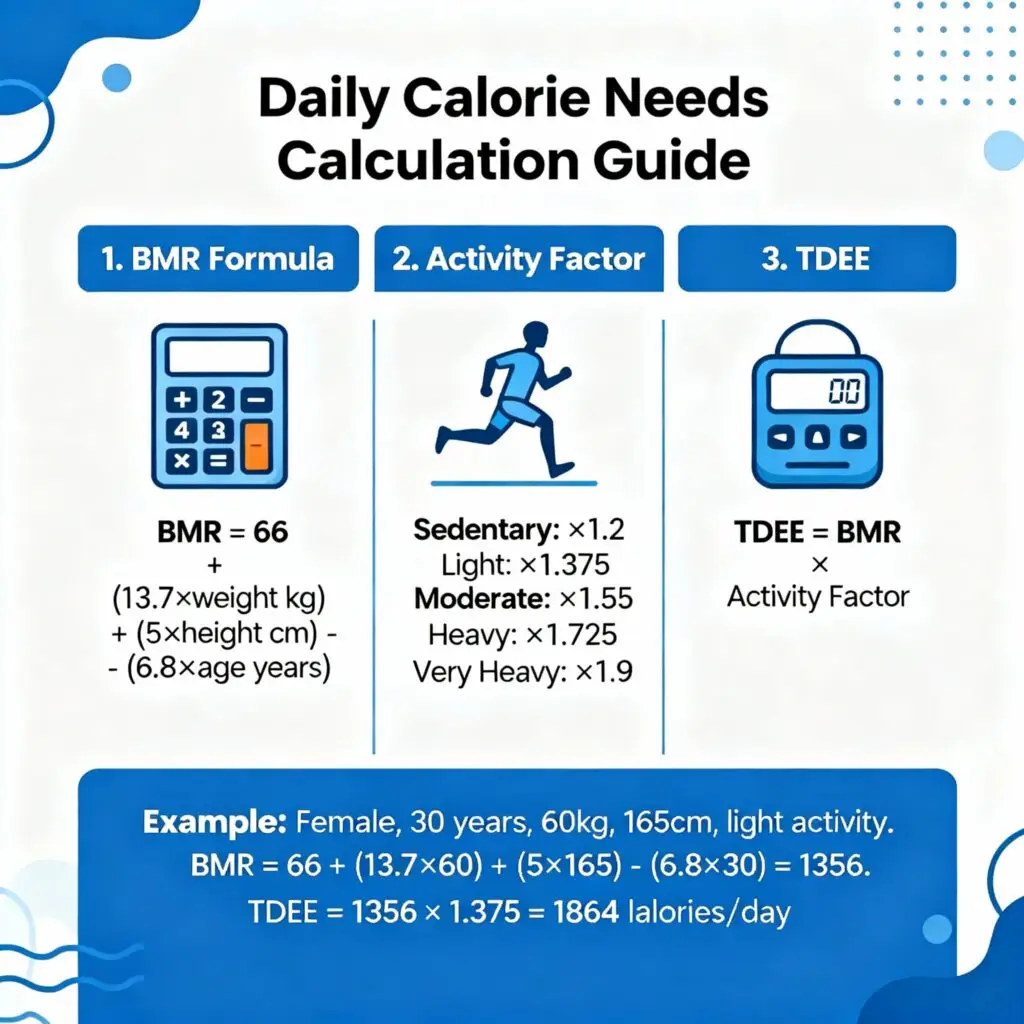
How Many Calories Do You Actually Need? Your TDEE Explained Simply
Most of us approach diet and fitness in a vague and intuitive understanding ” eating less and moving more”. Without knowing how much energy your body actually requires par day. that advice is like navigating without map. Total Daily Energy Expenditure (TDEE) is the precise and scientifically grounded figure that fills the gap.
Once you know your TDEE, eating for any goal becomes easy. Eat less than this number → you lose weight. Eat more → you gain weight. Eat the same → your weight stays the same. That is the whole game.
What Exactly Is TDEE?
Total Daily Energy Expenditure is the complete sum of all calories your body burns in a 24-hour period. It is not only what you burn on gym, nor it just what keep your heart breathing while you are sleeping. It is a full picture – every calorie consumed by every cellular activity, every muscle contraction, every thought, every meal digested.
Add all of that up — every calorie your body uses from the moment you wake up to the moment you fall asleep (and even while you sleep) — and that total is your TDEE.
TDEE vs BMR — What's the Difference?
BMR (Basal Metabolic Rate) = calories your body burns if you just lay completely still all day. Engine on but not moving.
TDEE = BMR + everything else (walking, eating, exercising, even fidgeting in your chair).
TDEE is always bigger than BMR, because real life involves a lot more than lying still.
The Four Components of TDEE
TDEE is not a single process — it is the sum of four distinct physiological components, each contributing a different share to your daily caloric expenditure. Understanding each individually allows you to see exactly where your energy goes.
1. BMR — The Calories You Burn Doing Absolutely Nothing
BMR stands for Basal Metabolic Rate. Think of it as the fuel your body needs just to keep the lights on. If you slept for 24 hours straight without moving, you would still burn your BMR worth of calories.
People with more muscle burn more calories at rest. Muscle is like an engine that keeps running even when you are sitting on the sofa. This is why building muscle is one of the best long-term strategies for staying lean.
BMR accounts for 60–75% of TDEE in most sedentary individuals — making it, by far, the largest contributor.

2. TEF — Eating Burns Calories Too
Every time you eat, your body has to work to break down the food. That work costs energy. This is called the Thermic Effect of Food (TEF).
The interesting part: protein costs your body the most energy to digest. Eat 100 calories of protein, and your body burns about 25 of those calories just processing it. Carbs cost only about 8, and fat costs almost nothing. This is one big reason high-protein diets work so well for weight loss.
It accounts for approximately 8–15% of TDEE.

3. Exercise — The Part You Already Know
Any time you work out — gym, run, swim, play sport — you burn extra calories. The amount depends on how hard you go and for how long. On a rest day, this part is zero. On a tough training day, it can add 500–800 extra calories to your burn.

4. NEAT — The Hidden Calorie Burner Most People Ignore
NEAT stands for Non-Exercise Activity Thermogenesis. Big name, simple meaning: all the movement you do in daily life that is not exercise. Walking to the bus. Pacing on a phone call. Tidying the house. Climbing stairs. Even fidgeting in your chair.
NEAT can differ by up to 2,000 calories per day between two people of the same size! This is the biggest reason some people stay slim without even trying — they just naturally move more throughout the day without thinking about it.

How to Calculate Your TDEE
Calculating TDEE involves two steps: first estimating your BMR using a validated equation, then multiplying it by an activity factor that reflects your lifestyle.
Step 1 — Estimate Your BMR
Mifflin–St Jeor Equation
The most widely validated and clinically referenced BMR formula is the Mifflin–St Jeor Equation, published in 1990 and repeatedly verified in subsequent research:
Formula 1 — Mifflin–St Jeor · Best for Most People
- Men: BMR = (10 × weight in kg) + (6.25 × height in cm) − (5 × age) + 5
- Women: BMR = (10 × weight in kg) + (6.25 × height in cm) − (5 × age) − 161
- BMR = (10 × 80) + (6.25 × 175) − (5 × 28) + 5
= 800 + 1093.75 − 140 + 5 = 1,759 calories/day
Harris–Benedict Equation
Some nutritionists also use the older Harris–Benedict Equation (1919, revised 1984). It gives slightly different numbers and is less accurate for modern populations, but remains widely referenced:
Formula 2 — Harris–Benedict · Good for a Quick Rough Number
- Men: BMR = 88.36 + (13.4 × weight kg) + (4.8 × height cm) − (5.7 × age)
- Women: BMR = 447.6 + (9.25 × weight kg) + (3.1 × height cm) − (4.3 × age)
Katch–McArdle Formula
If you know your body fat percentage, the most accurate formula of all is the Katch–McArdle Formula, which works directly from your lean body mass (the non-fat part of you):
Formula 2 — Katch–McArdle · Best If You Know Your Body Fat %
- Step 1: Lean Body Mass = Weight (kg) × (1 − body fat as a decimal)
- Step 2: BMR = 370 + (21.6 × Lean Body Mass)
- Lean Mass = 80 × (1 − 0.20) = 80 × 0.80 = 64 kg
- BMR = 370 + (21.6 × 64) = 370 + 1,382 = 1,752 calories/day
Fat barely burns any calories. This formula ignores your fat entirely and only counts your muscle and organs — the parts that actually need fuel. If you have a body fat reading from a smart scale or scan, this gives a more personal result.
Step 2 — Apply an Activity Multiplier
Once BMR is known, multiply it by the factor that best matches your average weekly activity level:
| Activity Level | Description | Multiplier |
|---|---|---|
| Sedentary | Desk job, little or no exercise | × 1.2 |
| Lightly Active | Light exercise 1–3 days/week | × 1.375 |
| Moderately Active | Moderate exercise 3–5 days/week | × 1.55 |
| Very Active | Hard exercise 6–7 days/week | × 1.725 |
| Extremely Active | Intense daily training or physical labour | × 1.9 |
The Final TDEE Formula — Putting It All Together
TDEE = 1,759 × 1.55 = ≈ 2,726 calories per day
This means he needs roughly 2,726 calories a day just to stay at his current weight.
Applying TDEE to Real-World Goals
Once you have established your TDEE, translating it into actionable dietary targets becomes straightforward. The three fundamental goals — fat loss, muscle gain, and weight maintenance — each require a specific relationship between caloric intake and expenditure.
Lose Fat
Stay Same Weight
Build Muscle
Factors That Influence Your TDEE
TDEE is not static — it is a living, responsive figure that shifts with your circumstances. Several key variables exert meaningful influence:
Age
Metabolism naturally slows down by about 1–2% every decade after your mid-twenties. This is mostly because reduction in lean muscle mass & hormonal changes as they age. The good news: if you keep doing resistance training and staying active, you can slow this down a lot.
Body Composition
Muscle burns roughly three times more calories at rest than body fat does. Two people can weigh exactly the same but have completely different TDEEs based on how much of their body is muscle. This is exactly why “building muscle boosts your metabolism” is true — it is not just fitness advice, it is biology.
Sex and Hormonal Profile
Biological males typically have higher BMRs than biological females of comparable size due to greater average muscle mass and higher testosterone levels. Hormonal fluctuations — including those related to the menstrual cycle, pregnancy, menopause, and thyroid function — can meaningfully shift TDEE over time.
Climate and Thermoregulation
Exposure to cold environments increases TDEE as the body burns additional energy to maintain core temperature through shivering thermogenesis and non-shivering thermogenesis (mediated by brown adipose tissue). This effect, while real, is modest in most indoor-living individuals.
Health and Medical Status
When you have a fever, your BMR goes up by about 10–13% for every extra degree of body temperature. Your body is working harder to fight the infection. This is also why you sometimes lose a little weight when sick, even though you are not trying to.
Dieting Too Hard for Too Long
If you eat very little for a long time, your body adapts to protect itself. It slows your metabolism, reduces how much you fidget and move throughout the day, and tries to hang on to every calorie it can. This is called metabolic adaptation — and it is the main reason crash diets stop working after a few weeks. Your TDEE actually drops to meet your low intake.
Common Misconceptions About TDEE
Myth #1 – “Eating very little will keep accelerating weight loss indefinitely.”
Fact – Prolonged severe caloric restriction triggers metabolic adaptation — the body downregulates TDEE by reducing NEAT, lowering body temperature, and preserving fat stores. This is why extreme diets typically plateau and often cause rebound weight gain.
Myth #2“TDEE is fixed and cannot be meaningfully changed.”
Myth #3 “Cardio is the best way to increase TDEE.”
Fact – Cardio burns calories during the session but does not significantly raise resting metabolic rate. Resistance training, by building muscle tissue, increases BMR persistently — 24 hours a day, including on rest days. Both forms of exercise have their place, but for long-term metabolic elevation, muscle mass is the more durable investment.
Practical Strategies to Optimize Your TDEE
Eat More Protein
Protein keeps you full for longer, costs your body more to digest, and protects your muscle when you are eating in a deficit. Aim for about 1.6 to 2.2 grams per kilogram of body weight per day. For a 70 kg person, that is roughly 112–154 grams of protein daily — chicken, eggs, fish, lentils, Greek yoghurt, tofu, cottage cheese.
Do Some Weight Training
Even just two or three sessions a week slowly builds muscle over months. More muscle means a higher BMR, which means a higher TDEE, which means you can eat more food without gaining weight. It is a long-term investment that keeps paying off for years.
Move More During the Day — Not Just at the Gym
Remember NEAT? Small daily habits add up fast. Walking more, taking the stairs instead of the lift, standing while on calls, doing your own household chores — a person who walks 8,000 steps a day can burn 300–400 more calories than someone who barely moves, even if both do the exact same gym workout.
Recalculate Every 4–8 Weeks
As your weight, muscle, and activity level change, so does your TDEE. If you have lost 5 kg, your new maintenance calories are lower. If you have built muscle, your maintenance is higher. Keep your numbers updated and your plan stays accurate.
The Formula is Just a Starting Point
All these formulas can be off by 200–300 calories because every human body is different. Use the formula to get started, then watch what actually happens to your weight over 2–3 weeks. If nothing is changing when it should be, adjust your intake by 100–200 calories in the right direction. Your real results will always be more accurate than any equation.
Frequently Asked Questions (FAQs)
I am eating below my TDEE but not losing weight. Why?
A few common reasons: you may be estimating your food intake incorrectly (liquid calories, cooking oils, and sauces add up fast), your activity multiplier may be too high, or your body may have adapted and lowered its TDEE over time. Try eating 100–150 fewer calories and wait two more weeks before panicking.
Is TDEE the same as maintenance calories?
Yes, exactly the same thing. “Maintenance calories” is just the everyday word for TDEE. Both mean: the number of calories at which your weight stays perfectly stable.
Do I need to recalculate my TDEE after losing weight?
Yes, and this is important. A lighter body burns fewer calories. If you have lost 5 kg or more, your old TDEE number is now too high. Recalculate every 4–8 weeks to keep your plan accurate and avoid hitting a weight loss plateau.
Conclusion
TDEE is just the total number of calories your body burns in a day. It is made up of four parts: your resting metabolism (the biggest chunk), the energy cost of digesting food, your actual exercise, and all the little movements you make throughout the day.
Knowing your TDEE turns confusing diet advice into a clear, actionable number. Eat less than it — lose fat. Eat more — gain weight. Eat the same — stay the same. Whether your goal is to lose weight, gain muscle, run faster, or simply nourish yourself well, TDEE is the foundation upon which all nutritional planning should be built.