
Nuts & Seeds: Vitamins, Minerals, Macros & Health Benefits
A comprehensive, evidence-based reference covering macronutrients, vitamins, minerals, per-serving data, phytochemicals, and key health benefits of 27 common Indian and international nuts and seeds — sourced from USDA FoodData Central, NIN India (IFCT 2017), and peer-reviewed literature.
Accessing accurate Nuts and Seeds Nutrition Facts is essential for balancing your intake of healthy fats and minerals. Our comprehensive Nuts and Seeds Nutrition Facts guide covers everything from macros to the RDA of healthy fats. By using this healthy nuts and seeds comparison, you can track the protein and omega-3 in seeds and the essential micronutrients in nuts and oilseeds. This Nuts and Seeds Nutrition Facts database is designed to help you optimize your brain health and energy levels.
Introduction
Nuts and seeds are among the most nutritionally dense foods on the planet — compact, shelf-stable, and delivering an extraordinary concentration of healthy fats, protein, fibre, vitamins, minerals, and bioactive compounds in every small handful. Across virtually every traditional food culture, from Ayurvedic medicine to Mediterranean diets to indigenous tribal foods, nuts and seeds have occupied a place of nutritional reverence.
Modern nutritional science has comprehensively validated this traditional wisdom. Large-scale prospective studies — including the PREDIMED trial, the Nurses’ Health Study, and multiple meta-analyses — demonstrate that regular nut and seed consumption is associated with significant reductions in all-cause mortality, cardiovascular disease, type 2 diabetes, and metabolic syndrome. The mechanisms are multifaceted: favourable fatty acid profiles, anti-inflammatory phytosterols, antioxidant polyphenols, and mineral bioavailability all contribute.
This article presents complete, verified nutrition data for 27 nuts and seeds, including several uniquely important Indian varieties — Groundnuts, Sesame, Flaxseeds, Lotus Seeds, Makhana (Fox Nuts), Fenugreek, Kalonji (Nigella), and Mustard Seeds — that are extensively used in Indian cuisine yet rarely appear in international nutrition databases.
Key Insight
A 28 g handful of mixed nuts provides approximately 170 kcal, 5 g protein, 15 g healthy fats, and meaningful amounts of Vitamin E, Magnesium, and Zinc — all in a form that is thermogenically less efficient than its raw calorie count suggests, meaning fewer calories are actually absorbed compared to processed foods with the same caloric value.
What Makes Nuts & Seeds Nutritionally Unique?
Unlike most food groups, nuts and seeds combine macronutrients, micronutrients, and bioactive phytochemicals in a remarkably dense, synergistic matrix. Several nutritional properties set them apart:
- Unsaturated Fat Dominance: Most nuts and seeds derive 70–90% of their fatty acids from MUFA and PUFA. Walnuts uniquely deliver 9.1 g of plant-based Omega-3 (ALA) per 100 g. Flaxseeds and Chia seeds are the richest plant sources of ALA globally.
- Complete & High-Quality Protein: Hemp seeds provide all nine essential amino acids in a near-ideal ratio. Pumpkin seeds deliver 30 g protein per 100 g — comparable to many animal proteins. Groundnuts are one of the richest plant sources of Arginine (3457 mg/100g).
- Dietary Fibre: Chia seeds (34.4 g fibre/100g), Flaxseeds (27.3 g), and Fenugreek seeds (24.6 g) are among the highest-fibre foods in any category. Soluble fibres form gels that lower LDL cholesterol and stabilise blood glucose.
- Fat-Soluble Vitamins: Sunflower seeds (35.2 mg Vit E/100g) and Almonds (25.6 mg) are among the richest food sources of Vitamin E globally. Pine Nuts provide Vitamin K at 53.9 µg/100g.
- Exceptional Mineral Density: Brazil Nuts contain 1917 µg Selenium/100g — a single nut provides a full day’s requirement. Poppy Seeds deliver 1438 mg Calcium/100g — more than dairy cheese.
- Unique Phytochemicals: Lignans (Flaxseeds), Thymoquinone (Kalonji/Nigella), Cucurbitin (Pumpkin Seeds), Sesamin/Sesamol (Sesame), and Diosgenin (Fenugreek) are bioactive compounds with documented anti-cancer, anti-inflammatory, and hormonal-regulatory properties.
- Anti-Nutrients (Important Context): Phytic acid, oxalates, and tannins are present in most nuts and seeds and reduce mineral bioavailability. Soaking (8–12 hours), sprouting, roasting, or fermenting substantially reduces anti-nutrient load and improves mineral absorption.
Practical Tip
Soaking almonds overnight reduces phytic acid by ~30% and tannin content significantly, improving absorption of Calcium, Iron, Zinc, and Magnesium. Always consume Brazil Nuts in moderation — just 1–2 per day is sufficient for Selenium; excess causes selenosis.

Macronutrient & Fat Profile (per 100 g)
All values represent the edible portion of raw/unprocessed nuts and seeds unless otherwise stated. Data sourced from USDA FoodData Central 2024 and IFCT 2017 (NIN, India).
| Nut / Seed | Energy (kcal) | Energy (kJ) | Water (g) | Total Fat (g) | Saturated FA (g) | Monounsaturated FA (g) | Polyunsaturated FA (g) | Omega-3 ALA (g) | Omega-6 LA (g) | Trans Fat (g) | Carbohydrate (g) | Dietary Fibre (g) | Total Sugars (g) | Protein (g) | Ash (g) |
|---|---|---|---|---|---|---|---|---|---|---|---|---|---|---|---|
| Chestnuts (raw) | 213 | 891 | 52.0 | 2.2 | 0.4 | 0.8 | 0.9 | 0.1 | 0.8 | 0.0 | 45.5 | 8.1 | 8.5 | 2.4 | 1.0 |
| Fenugreek Seeds | 323 | 1351 | 8.8 | 6.4 | 1.5 | 1.1 | 1.7 | 0.2 | 1.5 | 0.0 | 58.3 | 24.6 | 3.5 | 23.0 | 3.5 |
| Lotus Seeds (raw) | 332 | 1389 | 13.8 | 0.6 | 0.1 | 0.2 | 0.2 | 0.0 | 0.2 | 0.0 | 64.4 | 15.9 | 0.0 | 15.4 | 1.4 |
| Nigella / Kalonji Seeds | 345 | 1444 | 6.0 | 26.0 | 2.3 | 8.0 | 14.0 | 0.3 | 13.7 | 0.0 | 44.2 | 38.2 | 2.0 | 17.8 | 5.0 |
| Fox Nuts / Makhana (roasted) | 347 | 1452 | 13.4 | 0.1 | 0.0 | 0.0 | 0.1 | 0.0 | 0.1 | 0.0 | 76.9 | 14.5 | 0.0 | 9.7 | 0.1 |
| Roasted Bengal Gram (Chana) | 390 | 1632 | 9.9 | 6.0 | 0.8 | 2.2 | 2.7 | 0.0 | 2.7 | 0.0 | 60.6 | 17.4 | 5.8 | 19.3 | 3.4 |
| Chia Seeds (raw) | 486 | 2034 | 5.8 | 30.7 | 3.3 | 2.3 | 23.7 | 17.8 | 5.8 | 0.0 | 42.1 | 34.4 | 0.0 | 16.5 | 4.9 |
| Mustard Seeds (yellow) | 508 | 2126 | 6.9 | 36.2 | 1.9 | 21.2 | 10.1 | 0.9 | 9.2 | 0.0 | 27.0 | 12.2 | 6.8 | 25.8 | 4.1 |
| Poppy Seeds (raw) | 525 | 2197 | 5.9 | 41.6 | 5.8 | 15.7 | 18.0 | 0.3 | 17.7 | 0.0 | 28.1 | 19.3 | 2.6 | 17.9 | 6.6 |
| Flaxseeds / Linseed (raw) | 534 | 2234 | 6.9 | 42.2 | 3.7 | 7.5 | 28.7 | 22.8 | 5.9 | 0.0 | 28.9 | 27.3 | 1.6 | 18.3 | 3.7 |
| Cashew Nuts (raw) | 553 | 2314 | 5.2 | 43.9 | 7.8 | 23.8 | 7.8 | 0.1 | 7.7 | 0.0 | 30.2 | 3.3 | 5.9 | 18.2 | 2.7 |
| Hemp Seeds (hulled) | 553 | 2315 | 5.0 | 48.7 | 4.6 | 5.4 | 38.1 | 8.7 | 27.4 | 0.0 | 8.7 | 4.0 | 1.5 | 31.6 | 6.0 |
| Watermelon Seeds (dried) | 557 | 2331 | 4.8 | 47.4 | 12.0 | 14.4 | 18.1 | 0.3 | 17.8 | 0.0 | 15.3 | 2.7 | 4.5 | 28.3 | 4.2 |
| Melon Seeds (dried) | 557 | 2331 | 4.5 | 45.1 | 11.0 | 16.0 | 15.0 | 0.3 | 14.7 | 0.0 | 18.3 | 3.9 | 4.8 | 28.8 | 3.3 |
| Pumpkin Seeds / Pepitas (raw) | 559 | 2340 | 5.2 | 49.1 | 8.6 | 16.0 | 19.0 | 0.1 | 18.9 | 0.0 | 10.7 | 6.0 | 1.4 | 30.2 | 4.8 |
| Pistachios (raw) | 560 | 2344 | 4.4 | 45.4 | 5.9 | 23.7 | 13.7 | 0.3 | 13.5 | 0.0 | 27.2 | 10.6 | 7.7 | 20.2 | 2.9 |
| Peanuts / Groundnuts (raw) | 567 | 2373 | 6.5 | 49.2 | 6.8 | 24.4 | 15.6 | 0.0 | 15.6 | 0.0 | 16.1 | 8.5 | 4.7 | 25.8 | 2.3 |
| Sesame Seeds (raw) | 573 | 2397 | 4.7 | 49.7 | 7.0 | 18.8 | 21.8 | 0.4 | 21.4 | 0.0 | 23.5 | 11.8 | 0.3 | 17.7 | 4.5 |
| Almonds (raw) | 579 | 2423 | 4.4 | 49.9 | 3.8 | 31.6 | 12.4 | 0.0 | 12.3 | 0.0 | 21.6 | 12.5 | 4.4 | 21.2 | 3.0 |
| Sunflower Seeds (raw) | 584 | 2444 | 4.7 | 51.5 | 4.5 | 18.5 | 23.1 | 0.1 | 23.0 | 0.0 | 20.0 | 8.6 | 2.6 | 20.8 | 3.0 |
| Hazelnuts / Filberts (raw) | 628 | 2629 | 5.3 | 60.8 | 4.5 | 45.7 | 7.9 | 0.1 | 7.8 | 0.0 | 16.7 | 9.7 | 4.3 | 15.0 | 2.3 |
| Walnuts (raw) | 654 | 2738 | 4.1 | 65.2 | 6.1 | 8.9 | 47.2 | 9.1 | 38.1 | 0.0 | 13.7 | 6.7 | 2.6 | 15.2 | 1.8 |
| Brazil Nuts (raw) | 656 | 2744 | 3.5 | 66.4 | 15.1 | 24.5 | 23.1 | 0.0 | 23.1 | 0.0 | 12.3 | 7.5 | 2.3 | 14.3 | 3.5 |
| Coconut (dried/desiccated) | 660 | 2761 | 2.8 | 64.5 | 57.2 | 2.7 | 0.7 | 0.0 | 0.7 | 0.0 | 23.7 | 16.3 | 6.9 | 6.9 | 1.1 |
| Pine Nuts (raw) | 673 | 2817 | 2.9 | 68.4 | 4.9 | 18.8 | 34.1 | 0.1 | 33.2 | 0.0 | 13.1 | 3.7 | 3.6 | 13.7 | 2.9 |
| Pecans (raw) | 691 | 2892 | 3.5 | 72.0 | 6.2 | 40.8 | 21.6 | 1.1 | 20.6 | 0.0 | 13.9 | 9.6 | 3.9 | 9.2 | 1.4 |
| Macadamia Nuts (raw) | 718 | 3004 | 1.4 | 75.8 | 12.1 | 58.9 | 1.5 | 0.2 | 1.3 | 0.0 | 13.8 | 8.6 | 4.6 | 7.9 | 1.0 |
📋 Notable Observations
Highest fat: Macadamia (75.8 g) — dominated by rare palmitoleic acid (MUFA). Lowest fat: Makhana (0.1 g) and Lotus Seeds (0.6 g) — essentially fat-free. Highest protein: Hemp Seeds (31.6 g) and Pumpkin Seeds (30.2 g). Highest fibre: Kalonji (38.2 g) and Chia Seeds (34.4 g). Most balanced macro profile: Almonds — an ideal combination of fat, protein, and fibre in one nut.
Fat Quality — MUFA vs PUFA vs Saturated
The type of fat in nuts and seeds matters as much as the quantity. Cardiovascular guidelines consistently favour replacing saturated fats with MUFA and PUFA.
- Highest MUFA (heart-healthy oleic acid): Macadamia (58.9 g) → Hazelnuts (45.7 g) → Pecans (40.8 g) → Almonds (31.6 g)
- Highest PUFA (Omega-6 + Omega-3): Walnuts (47.2 g) → Hemp Seeds (38.1 g) → Pine Nuts (34.1 g) → Flaxseeds (28.7 g)
- Highest Omega-3 ALA (anti-inflammatory): Flaxseeds (22.8 g) → Chia Seeds (17.8 g) → Walnuts (9.1 g) → Hemp Seeds (8.7 g)
- Highest Saturated Fat (limit): Coconut (57.2 g) — primarily lauric acid (C12) which uniquely raises HDL alongside LDL; Brazil Nuts (15.1 g)
Low-Calorie
Several Indian-origin nuts and seeds have dramatically different macronutrient profiles from typical tree nuts — making them excellent options for calorie-conscious individuals:
Vitamin Content of Nuts & Seeds (per 100 g)
Nuts and seeds are the richest plant-food sources of Vitamin E, and contribute meaningfully to B-vitamins, Folate, and Vitamin K. The table below highlights the most nutritionally significant values.
| Nut / Seed | Vit A RAE (µg) | Beta-Carotene (µg) | Vit D (IU) | Vit E (mg α-TE) | Vit K (µg) | Vit C (mg) | Thiamine B1 (mg) | Riboflavin B2 (mg) | Niacin B3 (mg) | Pantothenic Acid B5 (mg) | Vit B6 (mg) | Folate DFE (µg) | Vit B12 (µg) | Choline (mg) | Betaine (mg) |
|---|---|---|---|---|---|---|---|---|---|---|---|---|---|---|---|
| Almonds (raw) | 0 | 1 | 0 | 25.6 | 0.0 | 0.0 | 0.2 | 1.1 | 3.6 | 0.5 | 0.1 | 44 | 0.0 | 52.1 | 0.5 |
| Cashew Nuts (raw) | 0 | 0 | 0 | 0.9 | 34.1 | 0.5 | 0.4 | 0.1 | 1.1 | 0.9 | 0.4 | 25 | 0.0 | 61.0 | 1.0 |
| Walnuts (raw) | 1 | 8 | 0 | 0.7 | 2.7 | 1.3 | 0.3 | 0.2 | 1.1 | 0.6 | 0.5 | 98 | 0.0 | 39.2 | 0.5 |
| Pistachios (raw) | 13 | 78 | 0 | 2.9 | 13.2 | 5.6 | 0.9 | 0.2 | 1.3 | 0.5 | 1.7 | 51 | 0.0 | 71.4 | 0.3 |
| Peanuts / Groundnuts (raw) | 0 | 0 | 0 | 8.3 | 0.0 | 0.0 | 0.6 | 0.1 | 12.1 | 1.8 | 0.4 | 240 | 0.0 | 52.5 | 0.4 |
| Macadamia Nuts (raw) | 0 | 0 | 0 | 0.5 | 0.0 | 1.2 | 1.2 | 0.2 | 2.5 | 0.8 | 0.3 | 11 | 0.0 | 12.0 | 0.1 |
| Brazil Nuts (raw) | 0 | 0 | 0 | 5.7 | 0.0 | 0.7 | 0.6 | 0.0 | 0.3 | 0.2 | 0.1 | 22 | 0.0 | 28.6 | 0.3 |
| Hazelnuts / Filberts (raw) | 1 | 8 | 0 | 15.3 | 14.2 | 6.3 | 0.6 | 0.1 | 1.8 | 0.9 | 0.6 | 113 | 0.0 | 45.6 | 0.3 |
| Pecans (raw) | 3 | 36 | 0 | 1.4 | 3.5 | 1.1 | 0.7 | 0.1 | 1.2 | 0.9 | 0.2 | 22 | 0.0 | 40.5 | 0.2 |
| Pine Nuts (raw) | 1 | 8 | 0 | 9.3 | 53.9 | 0.8 | 0.4 | 0.2 | 4.4 | 0.3 | 0.1 | 34 | 0.0 | 55.8 | 0.3 |
| Chestnuts (raw) | 1 | 7 | 0 | 0.5 | 81.5 | 40.2 | 0.2 | 0.2 | 1.1 | 0.5 | 0.4 | 70 | 0.0 | 33.0 | 0.8 |
| Coconut (dried/desiccated) | 0 | 0 | 0 | 0.4 | 0.0 | 1.5 | 0.1 | 0.0 | 0.4 | 0.8 | 0.3 | 26 | 0.0 | 12.5 | 0.4 |
| Flaxseeds / Linseed (raw) | 0 | 0 | 0 | 19.5 | 4.3 | 0.6 | 1.6 | 0.2 | 3.1 | 1.0 | 0.5 | 87 | 0.0 | 78.7 | 1.0 |
| Chia Seeds (raw) | 0 | 7 | 0 | 0.5 | 7.1 | 1.6 | 0.6 | 0.2 | 8.8 | 0.9 | 0.6 | 49 | 0.0 | 78.7 | 0.4 |
| Sesame Seeds (raw) | 0 | 5 | 0 | 0.3 | 0.0 | 0.0 | 0.8 | 0.3 | 4.5 | 0.1 | 0.8 | 97 | 0.0 | 25.6 | 0.4 |
| Sunflower Seeds (raw) | 5 | 30 | 0 | 35.2 | 0.0 | 1.4 | 1.5 | 0.4 | 6.8 | 1.1 | 1.4 | 227 | 0.0 | 55.1 | 0.5 |
| Pumpkin Seeds / Pepitas (raw) | 16 | 0 | 0 | 2.2 | 51.4 | 1.9 | 0.3 | 0.2 | 5.0 | 0.8 | 0.1 | 58 | 0.0 | 63.0 | 0.3 |
| Hemp Seeds (hulled) | 0 | 0 | 0 | 2.8 | 0.5 | 2.0 | 1.3 | 0.3 | 9.2 | 0.0 | 0.1 | 65 | 0.0 | 0.0 | 0.0 |
| Poppy Seeds (raw) | 0 | 0 | 0 | 0.0 | 0.0 | 1.0 | 0.9 | 0.1 | 0.9 | 0.3 | 0.3 | 48 | 0.0 | 14.0 | 0.0 |
| Watermelon Seeds (dried) | 0 | 0 | 0 | 0.0 | 0.0 | 1.8 | 0.2 | 0.1 | 3.8 | 0.2 | 0.1 | 16 | 0.0 | 0.0 | 0.0 |
| Lotus Seeds (raw) | 0 | 0 | 0 | 0.0 | 0.0 | 0.0 | 0.6 | 0.2 | 0.5 | 0.3 | 0.1 | 104 | 0.0 | 0.0 | 0.0 |
| Roasted Bengal Gram (Chana) | 3 | 17 | 0 | 0.8 | 9.5 | 2.0 | 0.5 | 0.2 | 2.9 | 0.4 | 0.2 | 186 | 0.0 | 48.0 | 0.4 |
| Fox Nuts / Makhana (roasted) | 0 | 0 | 0 | 0.0 | 0.0 | 0.0 | 0.1 | 0.1 | 0.1 | 0.1 | 0.1 | 18 | 0.0 | 10.0 | 0.0 |
| Melon Seeds (dried) | 0 | 0 | 0 | 0.0 | 0.0 | 0.0 | 0.2 | 0.1 | 3.8 | 0.2 | 0.1 | 16 | 0.0 | 0.0 | 0.0 |
| Nigella / Kalonji Seeds | 0 | 0 | 0 | 3.0 | 0.0 | 57.7 | 0.2 | 0.1 | 3.1 | 0.4 | 0.2 | 610 | 0.0 | 18.5 | 0.0 |
| Mustard Seeds (yellow) | 0 | 0 | 0 | 5.1 | 20.0 | 7.1 | 0.8 | 0.3 | 4.7 | 1.0 | 0.4 | 162 | 0.0 | 88.3 | 0.4 |
| Fenugreek Seeds | 0 | 1 | 0 | 0.3 | 10.0 | 3.0 | 0.3 | 0.4 | 1.6 | 0.9 | 0.6 | 57 | 0.0 | 0.0 | 0.0 |
Vitamin E — The Antioxidant Fat-Protector
Vitamin E (alpha-tocopherol) is the primary fat-soluble antioxidant in cell membranes, protecting PUFAs from oxidation. Nuts and seeds are the dominant dietary source. The RDA is 15 mg/day for adults.
- Sunflower Seeds: 35.2 mg/100 g — the richest whole-food source of Vit E
- Almonds: 25.6 mg/100 g — a 28g serving provides 7.1 mg (47% DV)
- Hazelnuts: 15.3 mg/100 g | Pine Nuts: 9.3 mg | Peanuts: 8.3 mg
- Flaxseeds: 19.5 mg/100 g — significantly higher than most nuts
- Brazil Nuts: 5.7 mg — meaningful, complemented by extraordinary Selenium
Science Note
Gamma-tocopherol — the form of Vitamin E dominant in Walnuts (21.3 mg), Sunflower Seeds (37.8 mg), and Peanuts (4.2 mg) — has distinct anti-inflammatory properties separate from alpha-tocopherol. It neutralises reactive nitrogen species and may be more protective against prostate cancer than alpha-tocopherol. Most supplements contain only alpha-tocopherol, making whole foods superior.
B-Vitamins — Energy Metabolism & Brain Health
- Thiamine (B1) — Highest: Flaxseeds (1.64 mg) → Sunflower Seeds (1.48 mg) → Hemp Seeds (1.28 mg) → Pistachios (0.87 mg). Critical for glucose-to-energy conversion.
- Niacin (B3) — Highest: Peanuts (12.07 mg/100g!) — far exceeds all other nuts. One 30g serving meets 50%+ of RDA. Hemp Seeds (9.2 mg), Chia Seeds (8.83 mg).
- Folate (B9) — Highest: Peanuts (240 µg) → Sunflower Seeds (227 µg) → Walnuts (98 µg) → Sesame (97 µg). Critical for DNA synthesis and pregnancy.
- B6 — Highest: Pistachios (1.70 mg/100g — exceptional) → Sunflower Seeds (1.35 mg) → Sesame (0.80 mg). B6 is essential for neurotransmitter synthesis.
- Pantothenic Acid (B5): Peanuts (1.77 mg) → Sunflower Seeds (1.13 mg) → Cashews (0.86 mg)
Vitamin K — Blood Clotting & Bone Metabolism
Vitamin K is less prominent in nuts generally, but notable exceptions exist:
- Pine Nuts: 53.9 µg/100g — the highest Vit K content among all nuts and seeds
- Cashews: 34.1 µg | Hazelnuts: 14.2 µg | Pistachios: 13.2 µg
- Pumpkin Seeds: 51.4 µg — unexpectedly high
- Mustard Seeds: 20 µg/100g — relevant as a daily spice
Mineral Content of Nuts & Seeds (per 100 g)
Nuts and seeds are extraordinary sources of minerals — often surpassing conventional food sources. However, anti-nutrients (primarily phytic acid) bind to minerals and reduce their bioavailability. Soaking, roasting, or sprouting can increase net mineral absorption by 20–50%.
| Nut / Seed | Calcium (mg) | Iron (mg) | Magnesium (mg) | Phosphorus (mg) | Potassium (mg) | Sodium (mg) | Zinc (mg) | Copper (mg) | Manganese (mg) | Selenium (µg) |
|---|---|---|---|---|---|---|---|---|---|---|
| Almonds (raw) | 264 | 3.7 | 270 | 481 | 705 | 1 | 3.1 | 1.0 | 2.2 | 4.1 |
| Cashew Nuts (raw) | 37 | 6.7 | 292 | 593 | 660 | 12 | 5.8 | 2.2 | 1.7 | 19.9 |
| Walnuts (raw) | 98 | 2.9 | 158 | 346 | 441 | 2 | 3.1 | 1.6 | 3.4 | 19.6 |
| Pistachios (raw) | 105 | 3.9 | 121 | 490 | 1025 | 1 | 2.2 | 1.3 | 1.2 | 10.0 |
| Peanuts / Groundnuts (raw) | 92 | 4.6 | 168 | 376 | 705 | 18 | 3.3 | 1.1 | 1.9 | 7.2 |
| Macadamia Nuts (raw) | 85 | 3.7 | 130 | 188 | 368 | 5 | 1.3 | 0.8 | 4.1 | 3.6 |
| Brazil Nuts (raw) | 160 | 2.4 | 376 | 725 | 659 | 3 | 4.1 | 1.8 | 1.2 | 1917 |
| Hazelnuts / Filberts (raw) | 114 | 4.7 | 163 | 290 | 680 | 0 | 2.4 | 1.7 | 6.2 | 2.4 |
| Pecans (raw) | 70 | 2.5 | 121 | 277 | 410 | 0 | 4.5 | 1.2 | 4.5 | 3.8 |
| Pine Nuts (raw) | 16 | 5.5 | 251 | 575 | 597 | 2 | 6.5 | 1.3 | 8.8 | 0.7 |
| Chestnuts (raw) | 19 | 0.9 | 30 | 93 | 518 | 3 | 0.5 | 0.4 | 1.0 | 1.2 |
| Coconut (dried/desiccated) | 26 | 3.3 | 90 | 206 | 543 | 37 | 1.6 | 0.7 | 1.2 | 18.5 |
| Flaxseeds / Linseed (raw) | 255 | 5.7 | 392 | 642 | 813 | 6 | 4.3 | 1.2 | 2.5 | 25.4 |
| Chia Seeds (raw) | 631 | 7.7 | 335 | 860 | 407 | 16 | 4.6 | 0.9 | 2.7 | 55.2 |
| Sesame Seeds (raw) | 975 | 14.6 | 351 | 629 | 468 | 11 | 7.8 | 4.1 | 2.5 | 34.4 |
| Sunflower Seeds (raw) | 78 | 5.3 | 325 | 660 | 645 | 9 | 5.0 | 1.8 | 2.0 | 53.0 |
| Pumpkin Seeds / Pepitas (raw) | 46 | 8.8 | 592 | 1233 | 809 | 7 | 7.6 | 1.4 | 4.5 | 9.4 |
| Hemp Seeds (hulled) | 70 | 8.0 | 700 | 1650 | 1200 | 5 | 9.9 | 1.6 | 7.6 | 27.0 |
| Poppy Seeds (raw) | 1438 | 9.8 | 347 | 870 | 719 | 26 | 7.9 | 1.6 | 6.7 | 13.5 |
| Watermelon Seeds (dried) | 15 | 7.3 | 515 | 755 | 648 | 2 | 10.2 | 0.4 | 1.2 | 0.0 |
| Lotus Seeds (raw) | 163 | 3.5 | 56 | 168 | 367 | 40 | 0.5 | 0.3 | 1.9 | 2.0 |
| Roasted Bengal Gram (Chana) | 202 | 4.6 | 138 | 331 | 875 | 24 | 3.0 | 0.7 | 1.2 | 7.5 |
| Fox Nuts / Makhana (roasted) | 20 | 1.4 | 67 | 212 | 500 | 100 | 0.5 | 0.1 | 1.0 | 2.4 |
| Melon Seeds (dried) | 46 | 7.3 | 515 | 755 | 648 | 2 | 10.2 | 0.4 | 1.2 | 0.0 |
| Nigella / Kalonji Seeds | 1.6 | 3.7 | 192 | 356 | 808 | 88 | 3.3 | 1.1 | 3.1 | 4.0 |
| Mustard Seeds (yellow) | 266 | 9.9 | 238 | 828 | 738 | 13 | 3.1 | 0.9 | 2.5 | 162 |
| Fenugreek Seeds | 176 | 33.5 | 191 | 296 | 770 | 67 | 2.7 | 1.1 | 1.2 | 6.3 |
Selenium
Brazil Nuts are the single most concentrated dietary source of Selenium on earth — by an enormous margin. Selenium is essential for thyroid hormone synthesis, immune function, and antioxidant defence (as part of Glutathione Peroxidase enzymes).
Critical Caution
Brazil Nuts: 1917 µg Selenium per 100 g. The RDA is 55 µg/day; the Tolerable Upper Limit is 400 µg/day. A single Brazil Nut (~5g) provides ~96 µg — just over the RDA. Eating 6–8 Brazil Nuts daily can cause selenosis: hair/nail loss, garlic breath, nerve damage. Limit to 1–2 Brazil Nuts per day maximum.
Magnesium
Magnesium is involved in over 300 enzymatic reactions and is chronically deficient in modern diets. Nuts and seeds are among the best dietary sources. RDA: 310–420 mg/day for adults.
- Hemp Seeds: 700 mg/100g — the richest magnesium source in this database
- Pumpkin Seeds: 592 mg | Brazil Nuts: 376 mg | Flaxseeds: 392 mg
- Almonds: 270 mg | Cashews: 292 mg | Sesame: 351 mg
- A 30 g serving of Pumpkin Seeds provides ~178 mg Magnesium — 42–57% of the daily RDA
Calcium
Poppy Seeds (1438 mg Ca/100g), Sesame Seeds (975 mg), and Chia Seeds (631 mg) are extraordinary calcium sources — far exceeding dairy. However, bioavailability is lower due to oxalates and phytates.
- Poppy Seeds: 1438 mg/100g — a single tablespoon (9g) provides 129 mg Ca
- Sesame Seeds (unhulled): 975 mg — tahini is an excellent calcium-rich condiment
- Chia Seeds: 631 mg — gel-forming makes it easier to use regularly
- Almonds: 264 mg | Fenugreek: 176 mg | Lotus Seeds: 163 mg
- Kalonji: Only 1.6 mg Ca but high Magnesium (192 mg) and Potassium (808 mg) as a spice seed
Iron
Non-heme iron from plant sources has lower bioavailability (2–20%) compared to heme iron (15–35%) from meat. Consuming iron-rich seeds with Vitamin C dramatically improves absorption. RDA: 8 mg (men), 18 mg (women).
- Fenugreek Seeds: 33.5 mg/100g — exceptional; use as spice daily
- Pumpkin Seeds: 8.8 mg | Hemp Seeds: 7.95 mg | Sesame: 14.6 mg
- Chia Seeds: 7.7 mg | Cashews: 6.7 mg | Watermelon Seeds: 7.3 mg
- Pair iron-rich seeds with Vitamin C sources (lime, amla, tomato) to maximise absorption
Zinc
Zinc is critical for immune function, wound healing, protein synthesis, and taste/smell. RDA: 8–11 mg/day. Phytates in seeds chelate zinc, but roasting or soaking improves bioavailability.
- Watermelon Seeds: 10.2 mg/100g | Hemp Seeds: 9.9 mg | Pumpkin Seeds: 7.6 mg
- Sesame Seeds: 7.8 mg | Cashews: 5.8 mg | Sunflower Seeds: 5.0 mg
Nutrition per Serving — Real-World Intake
Per-100g data is useful for comparison, but real consumption varies. Most nuts are eaten in 28–30g handfuls; seeds in 9–28g tablespoon portions. Below are key nutrients at realistic serving sizes.
| Nut / Seed | Serving Size (g) | Common Measure | Energy (kcal) | Total Fat (g) | Sat FA (g) | MUFA (g) | PUFA (g) | Omega-3 (g) | Carbs (g) | Fibre (g) | Sugars (g) | Protein (g) | Calcium (mg) | Iron (mg) | Magnesium (mg) | Zinc (mg) | Vit E (mg) |
|---|---|---|---|---|---|---|---|---|---|---|---|---|---|---|---|---|---|
| Almonds (raw) | 28 | ~23 almonds | 162.1 | 1.06 | 8.85 | 3.47 | 0 | 3.44 | 6.05 | 3.5 | 1.23 | 5.94 | 73.9 | 1.04 | 75.6 | 134.68 | 7.17 |
| Cashew Nuts (raw) | 28 | ~18 cashews | 154.8 | 2.18 | 6.66 | 2.18 | 0.03 | 2.16 | 8.46 | 0.92 | 1.65 | 5.1 | 10.4 | 1.88 | 81.8 | 166.04 | 0.25 |
| Walnuts (raw) | 28 | ~7 halves | 183.1 | 1.71 | 2.49 | 13.22 | 2.55 | 10.67 | 3.84 | 1.88 | 0.73 | 4.26 | 27.4 | 0.81 | 44.2 | 96.88 | 0.2 |
| Pistachios (raw) | 28 | ~49 kernels | 156.8 | 1.65 | 6.64 | 3.84 | 0.08 | 3.78 | 7.62 | 2.97 | 2.16 | 5.66 | 29.4 | 1.09 | 33.9 | 137.2 | 0.81 |
| Peanuts / Groundnuts (raw) | 28 | ~28 kernels | 158.8 | 1.9 | 6.83 | 4.37 | 0 | 4.37 | 4.51 | 2.38 | 1.32 | 7.22 | 25.8 | 1.29 | 47 | 105.28 | 2.32 |
| Macadamia Nuts (raw) | 28 | ~10-12 nuts | 201 | 3.39 | 16.49 | 0.42 | 0.06 | 0.36 | 3.86 | 2.41 | 1.29 | 2.21 | 23.8 | 1.04 | 36.4 | 52.64 | 0.14 |
| Brazil Nuts (raw) | 28 | ~6 nuts | 183.7 | 4.23 | 6.86 | 6.47 | 0 | 6.47 | 3.44 | 2.1 | 0.64 | 4 | 44.8 | 0.67 | 105.3 | 203 | 1.6 |
| Hazelnuts / Filberts (raw) | 28 | ~21 nuts | 175.8 | 1.26 | 12.8 | 2.21 | 0.03 | 2.18 | 4.68 | 2.72 | 1.2 | 4.2 | 31.9 | 1.32 | 45.6 | 81.2 | 4.28 |
| Pecans (raw) | 28 | ~19 halves | 193.5 | 1.74 | 11.42 | 6.05 | 0.31 | 5.77 | 3.89 | 2.69 | 1.09 | 2.58 | 19.6 | 0.7 | 33.9 | 77.56 | 0.39 |
| Pine Nuts (raw) | 28 | ~160 kernels | 188.4 | 1.37 | 5.26 | 9.55 | 0.03 | 9.3 | 3.67 | 1.04 | 1.01 | 3.84 | 4.5 | 1.54 | 70.3 | 161 | 2.6 |
| Chestnuts (raw) | 50 | 2-3 medium | 106.5 | 0.2 | 0.4 | 0.45 | 0.05 | 0.4 | 22.75 | 4.05 | 4.25 | 1.2 | 9.5 | 0.45 | 15 | 46.5 | 0.25 |
| Coconut (dried/desiccated) | 15 | 1 tbsp | 99 | 8.58 | 0.41 | 0.1 | 0 | 0.1 | 3.55 | 2.44 | 1.03 | 1.03 | 3.9 | 0.49 | 13.5 | 30.9 | 0.06 |
| Flaxseeds / Linseed (raw) | 14 | 1 tbsp | 74.8 | 0.52 | 1.05 | 4.02 | 3.19 | 3.2 | 4.05 | 3.82 | 0.22 | 2.56 | 35.7 | 0.8 | 54.9 | 89.88 | 2.73 |
| Chia Seeds (raw) | 28 | 2 tbsp | 136.1 | 0.92 | 0.64 | 6.64 | 4.98 | 1.62 | 11.79 | 9.63 | 0 | 4.62 | 176.7 | 2.16 | 93.8 | 240.8 | 0.14 |
| Sesame Seeds (raw) | 9 | 1 tbsp | 51.6 | 0.63 | 1.69 | 1.96 | 0.04 | 1.93 | 2.11 | 1.06 | 0.03 | 1.59 | 87.8 | 1.31 | 31.6 | 56.61 | 0.02 |
| Sunflower Seeds (raw) | 28 | ~3 tbsp | 163.5 | 1.26 | 5.18 | 6.47 | 0.03 | 6.44 | 5.6 | 2.41 | 0.73 | 5.82 | 21.8 | 1.48 | 91 | 184.8 | 9.86 |
| Pumpkin Seeds / Pepitas (raw) | 28 | ~3 tbsp | 156.5 | 2.41 | 4.48 | 5.32 | 0.03 | 5.29 | 3 | 1.68 | 0.39 | 8.46 | 12.9 | 2.46 | 165.8 | 345.24 | 0.62 |
| Hemp Seeds (hulled) | 30 | 3 tbsp | 165.9 | 1.38 | 1.62 | 11.43 | 2.61 | 8.22 | 2.61 | 1.2 | 0.45 | 9.48 | 21 | 2.38 | 210 | 495 | 0.84 |
| Poppy Seeds (raw) | 9 | 1 tbsp | 47.2 | 0.52 | 1.41 | 1.62 | 0.03 | 1.59 | 2.53 | 1.74 | 0.23 | 1.61 | 129.4 | 0.88 | 31.2 | 78.3 | 0 |
| Watermelon Seeds (dried) | 28 | ~3 tbsp | 156 | 3.36 | 4.03 | 5.07 | 0.08 | 4.98 | 4.28 | 0.76 | 1.26 | 7.92 | 4.2 | 2.04 | 144.2 | 211.4 | 0 |
| Lotus Seeds (raw) | 20 | ~10 seeds | 66.4 | 0.02 | 0.04 | 0.04 | 0 | 0.04 | 12.88 | 3.18 | 0 | 3.08 | 32.6 | 0.7 | 11.2 | 33.6 | 0 |
| Roasted Bengal Gram (Chana) | 30 | ~2 tbsp | 117 | 0.24 | 0.66 | 0.81 | 0 | 0.81 | 18.18 | 5.22 | 1.74 | 5.79 | 60.6 | 1.38 | 41.4 | 99.3 | 0.24 |
| Fox Nuts / Makhana (roasted) | 30 | ~1 cup popped | 104.1 | 0 | 0 | 0.03 | 0 | 0.03 | 23.07 | 4.35 | 0 | 2.91 | 6 | 0.42 | 20.1 | 63.6 | 0 |
| Melon Seeds (dried) | 28 | ~3 tbsp | 156 | 3.08 | 4.48 | 4.2 | 0.08 | 4.12 | 5.12 | 1.09 | 1.34 | 8.06 | 12.9 | 2.04 | 144.2 | 211.4 | 0 |
| Nigella / Kalonji Seeds | 5 | 1 tsp | 17.2 | 0.11 | 0.4 | 0.7 | 0.01 | 0.69 | 2.21 | 1.91 | 0.1 | 0.89 | 0.1 | 0.19 | 9.6 | 17.8 | 0.15 |
| Mustard Seeds (yellow) | 5 | 1 tsp | 25.4 | 0.1 | 1.06 | 0.51 | 0.05 | 0.46 | 1.35 | 0.61 | 0.34 | 1.29 | 13.3 | 0.5 | 11.9 | 41.4 | 0.26 |
| Fenugreek Seeds | 5 | 1 tsp | 16.2 | 0.08 | 0.06 | 0.09 | 0.01 | 0.08 | 2.92 | 1.23 | 0.18 | 1.15 | 8.8 | 1.68 | 9.6 | 14.8 | 0.01 |
Serving Size Insights
A standard 28g handful of Almonds provides ~162 kcal, 6g protein, 3.5g fibre, and ~7.3 mg Vitamin E (~49% DV). One tablespoon (14g) of Flaxseeds delivers ~3.2g Omega-3 ALA — about twice the recommended daily intake. Just 30g of Hemp Seeds provides ~9–10g complete protein with all essential amino acids. Two tablespoons (28g) of Chia Seeds supply ~9.6g fibre (~34% DV) along with ~177mg Calcium (~13% DV).
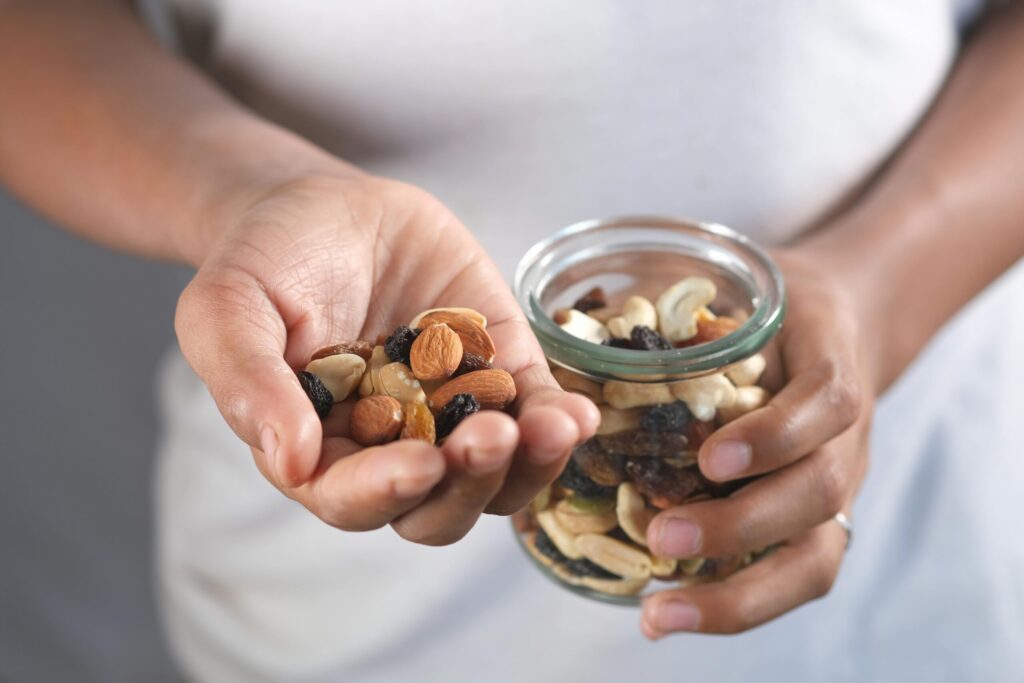
Highest Protein (per 28g serving)
Hemp Seeds
- ~9.5g protein
- Contains all essential amino acids (complete protein)
Highest Fibre (per 28g / ~2 tbsp)
Chia Seeds
- ~9.6g fibre
- ~34% of Daily Value (DV)
Highest Omega-3 (per 1 tbsp / ~14g)
Flaxseeds
- ~3.2g ALA (Alpha-Linolenic Acid)
Highest Vitamin E (per 28g)
Sunflower Seeds
- ~9.9 mg Vitamin E
- ~66% of Daily Value (DV)
Highest Magnesium (per 28g)
Pumpkin Seeds
- ~150–170 mg Magnesium
- ~35–45% of Daily Value (DV) (varies slightly by source)
Highest Calcium (per 1 tbsp / ~9g)
Poppy Seeds
- ~120–130 mg Calcium
- ~10% of Daily Value (DV)
Most Calorie-Efficient Option
Makhana (Fox Nuts) – per 30g
- ~100–110 kcal
- ~2.5–3g protein
- ~4–5g fibre
Best Indian Functional Spice Seed
Fenugreek Seeds (1 tsp / ~5g)
- ~1.5–1.7 mg Iron
- ~1–1.2g fibre
- Contains diosgenin (supports metabolism & hormonal balance)
Phytochemicals & Bioactive Compounds
Beyond standard macronutrients and micronutrients, nuts and seeds contain a rich library of bioactive compounds — many with potent medicinal properties documented in both traditional systems and modern clinical research. This is perhaps where nuts and seeds most profoundly separate themselves from simply being “calorie sources.”
| Nut / Seed | Phytic Acid (mg/100g) | Oxalic Acid (mg/100g) | Tannins (mg/100g) | Total Polyphenols (mg GAE/100g) | Notable Phytosterols (mg/100g) | Resveratrol (µg/100g) | Gamma-Tocopherol (mg/100g) | Arginine (mg/100g) | Notable Bioactives / Unique Compounds | Health Notes |
|---|---|---|---|---|---|---|---|---|---|---|
| Almonds (raw) | 1138 | 459 | 62 | 287 | 143 | 0 | 21.8 | 2492 | Amygdalin (trace in skin), Naringenin, Catechins | Skin contains highest polyphenols; blanched almonds lose ~30% polyphenols |
| Cashew Nuts (raw) | 994 | 13 | 0 | 93 | 150 | 0 | 5.3 | 2123 | Cardanol (shell), Anacardic acid (shell only; safe in nut) | CASHEW APPLE has 5× more Vit C than oranges; shell oil toxic |
| Walnuts (raw) | 982 | 74 | 0 | 1575 | 113 | 13.6 | 21.3 | 2278 | Ellagitannins, Juglone, Pedunculagin, Tellimagrandin | Walnuts highest nut Omega-3; skin tannins anti-tumour in vitro |
| Pistachios (raw) | 228 | 60 | 18 | 860 | 214 | 0 | 1.8 | 2031 | Lutein + Zeaxanthin 1405 µg (highest among nuts), Anthocyanins (purple types) | Green-purple skins; carotenoids linked to eye health |
| Peanuts / Groundnuts (raw) | 1760 | 22 | 305 | 312 | 208 | 0 | 4.2 | 3457 | Resveratrol (skin), p-Coumaric acid, Isoflavones | Groundnut skin: resveratrol; boiling increases polyphenols |
| Macadamia Nuts (raw) | 192 | 0 | 0 | 24 | 198 | 0 | 0 | 1397 | Palmitoleic acid (16:1 n-7) — rare in nuts; anti-inflammatory | Highest in palmitoleic acid; low polyphenol content |
| Brazil Nuts (raw) | 1719 | 0 | 0 | 89 | 95 | 0 | 7 | 2146 | Selenium 1917 µg/100g (world's richest source!); Phytate | Just 1 nut covers ~day's Se; excess → selenosis; cyanogenic glycosides (trace) |
| Hazelnuts / Filberts (raw) | 650 | 36 | 122 | 511 | 128 | 0 | 24.9 | 2147 | Proanthocyanidins, Quercetin, Kaempferol, β-Sitosterol | Rich in proanthocyanidins; skin key source |
| Pecans (raw) | 836 | 26 | 188 | 493 | 157 | 0 | 6 | 1180 | Ellagic acid, Vitexin, Quercetin-3-glucoside | Pecan skin: highest antioxidant activity among tree nuts (ORAC 17,940) |
| Pine Nuts (raw) | 0 | 0 | 0 | 68 | 41 | 0 | 9 | 2413 | Pinolenic acid (5-6% of FA) — unique to pine nuts; GLP-1 trigger | Pinolenic acid stimulates appetite-suppressing hormones CCK & GLP-1 |
| Chestnuts (raw) | 0 | 43 | 0 | 93 | 0 | 0 | 0 | 186 | Tannins (low), β-Sitosterol, Scopoletin | Low fat, high starch; good for gluten-free; high VC |
| Coconut (dried/desiccated) | 0 | 0 | 0 | 41 | 256 | 0 | 0 | 330 | Lauric acid 44% (anti-microbial); MCT rich; polyphenols low | Lauric acid raises HDL; MCTs → ketone bodies; high SFA raises debate |
| Flaxseeds / Linseed (raw) | 2160 | 0 | 0 | 2050 | 198 | 0 | 22.7 | 1980 | Lignans (SDG→Enterolactone); ALA 22.8g; Mucilage gum | Highest lignan content of any food; SDG is oestrogenic phytoestrogen; ALA precursor EPA/DHA |
| Chia Seeds (raw) | 860 | 0 | 0 | 400 | 176 | 0 | 0.6 | 1228 | Quercetin, Kaempferol, Caffeic acid, Chlorogenic acid, Mucilage | Highest dietary fibre of all seeds; forms gel in water (great prebiotic) |
| Sesame Seeds (raw) | 1400 | 0 | 40 | 980 | 400 | 0 | 0.16 | 3450 | Sesamolin, Sesamin, Sesamol, Sesaminol (lignans) | Sesamin: potent liver antioxidant; sesamol anti-inflammatory; phytate reduces mineral absorption |
| Sunflower Seeds (raw) | 949 | 25 | 0 | 1230 | 534 | 0 | 37.8 | 2400 | Chlorogenic acid, Caffeic acid, β-Sitosterol, Tryptophan | Highest Vit E (35.2mg) + Selenium (53µg); Tryptophan→Serotonin |
| Pumpkin Seeds / Pepitas (raw) | 4300 | 0 | 0 | 1200 | 326 | 0 | 2.1 | 6960 | Cucurbitacins, Cucurbitin (deworming), β-Sitosterol | Cucurbitin — anti-parasitic; Pumpkin seed oil in BPH management |
| Hemp Seeds (hulled) | 1600 | 0 | 0 | 400 | 190 | 0 | 8.5 | 6900 | GLA (0.8g/100g), CBC, CBD (trace plant), γ-Linolenic acid | Only complete plant protein (all 9 EAAs); GLA → anti-inflammatory prostaglandins; no THC |
| Poppy Seeds (raw) | 1080 | 0 | 204 | 1430 | 276 | 0 | 0 | 1900 | Morphine (trace <4µg/g in processed); Papaverine, Noscapine (trace) | Commercially de-narcotised; extremely high calcium 1438 mg; good for bone health |
| Watermelon Seeds (dried) | 400 | 0 | 0 | 400 | 0 | 0 | 0 | 1200 | Cucurbitin, Linoleic acid | Good zinc content; trypsin inhibitors (reduced by roasting) |
| Lotus Seeds (raw) | 500 | 0 | 0 | 150 | 0 | 0 | 0 | 900 | Alkaloids (nuciferine, lotusine, liensinine), Quercetin, Kaempferol | Nuciferine: sedative & antipsychotic properties; used in Ayurveda |
| Roasted Bengal Gram (Chana) | 600 | 20 | 120 | 200 | 0 | 0 | 0 | 1500 | Isoflavones (Biochanin-A, Formononetin), Pinitol | Pinitol — insulin sensitiser; good for diabetics (Indian traditional food) |
| Fox Nuts / Makhana (roasted) | 350 | 0 | 0 | 80 | 0 | 0 | 0 | 400 | Starch (76.9%!), Trace alkaloids, Kaempferol glycosides | Extremely low fat; high magnesium; traditional Indian snack; Ayurvedic sattvic food |
| Melon Seeds (dried) | 400 | 0 | 0 | 500 | 0 | 0 | 0 | 1600 | Cucurbitacins (trace), Linoleic acid | Similar profile to pumpkin seeds; good zinc source |
| Nigella / Kalonji Seeds | 3400 | 0 | 0 | 5290 | 276 | 0 | 0 | 1490 | Thymoquinone (TQ) — anti-cancer, anti-inflammatory; Thymohydroquinone | Thymoquinone: most studied phytochemical of kalonji; used in Unani/Ayurveda; anti-H. pylori |
| Mustard Seeds (yellow) | 987 | 0 | 35 | 870 | 344 | 0 | 3.7 | 2340 | Glucosinolates (Sinigrin, Sinalbin→Allyl isothiocyanate), Isoflavones | AITC: anti-cancer (Nrf2 pathway); Myrosinase activated on grinding; high selenium 162 µg |
| Fenugreek Seeds | 4950 | 0 | 53 | 1290 | 176 | 0 | 0 | 1550 | Diosgenin (steroidal saponin), 4-Hydroxyisoleucine (HI-Ile), Trigonelline, Galactomannan | HI-Ile: insulin secretagogue; Diosgenin: precursor to sex hormones in pharma; Trigonelline→Niacin on roasting |
Star Bioactives
Thymoquinone (Kalonji / Nigella Seeds)
Thymoquinone (TQ) is the principal bioactive of Nigella sativa (Kalonji) seeds. Over 600 published studies have documented its anti-inflammatory, anti-cancer (via apoptosis induction in cancer cell lines), anti-diabetic, and hepatoprotective effects. TQ inhibits NF-κB signalling — one of the master switches of chronic inflammation. Kalonji has 5290 mg GAE total polyphenols per 100g — among the highest of any seed. Used in Islamic prophetic medicine (Hadith: “a cure for everything except death”), Ayurveda, and Unani traditions for millennia.
SDG Lignan (Flaxseeds)
Secoisolariciresinol diglucoside (SDG) in Flaxseeds is converted by gut bacteria to Enterolactone and Enterodiol — mammalian lignans with phytoestrogenic and anti-oestrogenic activity. Flaxseeds contain the highest lignan content of any food (2050 mg GAE polyphenols/100g + ~2160 mg phytic acid). Multiple RCTs show 30g/day of ground flaxseeds reduces LDL cholesterol by 8–12% and may reduce breast cancer risk in postmenopausal women. Must be ground for SDG bioavailability — whole seeds pass through largely undigested.
Sesamin & Sesamol (Sesame Seeds)
Sesame seeds contain the lignans Sesamin, Sesamolin, and Sesamol — collectively among the most potent natural antioxidants known. Sesamol suppresses NF-κB, inhibits lipid peroxidation, and shows hepatoprotective activity in animal studies. Sesamin enhances Vitamin E activity by inhibiting its catabolism. The combination of these lignans with Vitamin E makes Sesame oil uniquely stable against oxidation — explaining its 3,000-year history in Indian and East Asian cooking.
Diosgenin & 4-Hydroxyisoleucine (Fenugreek Seeds)
Fenugreek contains Diosgenin — a steroidal saponin used as a pharmaceutical precursor to sex hormones, cortisone, and other steroids. 4-Hydroxyisoleucine (4-OH-Ile) is a unique amino acid found almost exclusively in Fenugreek that directly stimulates insulin secretion in a glucose-dependent manner — without causing hypoglycaemia. Clinical trials show 10–25g/day of Fenugreek seed powder significantly lowers post-meal blood glucose and HbA1c in type 2 diabetics. Galactomannan (soluble fibre) further slows glucose absorption.
Cucurbitin (Pumpkin Seeds)
Cucurbitin is an amino acid unique to the Cucurbita family (pumpkins, squash). It is the active anti-parasitic compound in pumpkin seeds — used for millennia to expel intestinal parasites, particularly tapeworms. Pumpkin seed extract standardised to cucurbitin content is now clinically used in benign prostatic hyperplasia (BPH) management, with several RCTs showing significant improvement in urinary symptoms. Pumpkin seeds also contain the highest Arginine content (6960 mg/100g) of any food in this database.
Anti-Nutrients
Anti-nutrients in nuts and seeds often get attention for negative reasons, but context is essential:
Phytic Acid:
Highest in Fenugreek (4950 mg), Pumpkin Seeds (4300 mg), Kalonji (3400 mg). Binds to Iron, Zinc, Calcium, Magnesium reducing bioavailability. Soaking, sprouting, fermenting, and roasting reduce phytate content by 20–60%.
Oxalic Acid:
Almonds (459 mg/100g) — highest among nuts. Can form kidney stones in predisposed individuals. Blanching reduces oxalate content significantly.
Tannins:
Highest in Walnuts and Pecans (skin). Act as antioxidants in moderate amounts; reduce protein digestibility in excess. Removing skins reduces tannin load.
Protective Role:
Phytates act as powerful antioxidants in the colon and may reduce colon cancer risk. The same compounds that reduce mineral absorption also inhibit tumour growth signalling. Context of overall diet determines net effect.
Health Benefits by Category
Tree Nuts — Cardiovascular & Brain Health
Tree nuts (Almonds, Walnuts, Cashews, Pistachios, Hazelnuts, Pecans, Macadamia, Brazil Nuts, Pine Nuts) are the most comprehensively studied food group for cardiovascular benefit. The landmark PREDIMED trial (7,447 participants) demonstrated a 30% relative risk reduction in major cardiovascular events with a Mediterranean diet supplemented with nuts. Mechanisms include LDL reduction (via MUFA/PUFA), HDL elevation, endothelial function improvement (via Arginine → Nitric Oxide), and anti-inflammatory polyphenol action.
Walnuts are unique among nuts — their 9.1 g Omega-3 ALA per 100g, ellagitannins (converted to Urolithins by gut bacteria), and Juglone make them specifically neuroprotective. Regular walnut consumption is associated with improved cognitive performance, reduced anxiety, and better memory in older adults in multiple RCTs.
Pistachios are the only nuts with meaningful amounts of Lutein and Zeaxanthin (1405 µg/100g combined) — carotenoids that protect the macula from age-related degeneration. Their purple-red skin varieties contain anthocyanins, giving them the highest antioxidant activity among commonly available nuts after Pecans.
Seeds — Omega-3, Fibre & Hormonal Balance
Seeds — particularly Flaxseeds, Chia, and Hemp — are the plant kingdom’s most concentrated sources of Omega-3 fatty acids, dietary fibre, and hormone-modulating lignans.
Chia Seeds absorb up to 12 times their weight in water, forming a hydrogel that slows gastric emptying, stabilises blood glucose, and creates prolonged satiety. Their 34.4 g/100g fibre content — predominantly soluble mucilage — feeds Bifidobacterium and Lactobacillus species, improving gut microbiome diversity. Chia seeds also deliver 631 mg Calcium and 7.7 mg Iron per 100g — making them exceptionally useful in plant-based diets.
Hemp Seeds stand alone in being the only plant food with a complete protein profile in an optimal omega-6:omega-3 ratio (3:1) alongside GLA (gamma-linolenic acid), which is converted to anti-inflammatory prostaglandins. Hemp seeds do not contain psychoactive THC in commercial food products.
Indian Seeds & Spice Seeds — Medicinal & Metabolic
Indian culinary seeds — Sesame, Fenugreek, Mustard, Kalonji, and Poppy — occupy a unique dual role as both nutrient sources and medicinal agents. Their daily use as spices in Indian cooking provides clinically meaningful doses of bioactive compounds:
- Fenugreek (Methi): 1 teaspoon (5g) daily provides Diosgenin and 4-OH-Ile for blood sugar regulation; 1.67g Fe and 0.95g fibre — meaningful as a habitual spice
- Mustard Seeds: Glucosinolates → Allyl Isothiocyanate (AITC) activated on grinding — activates Nrf2 pathway (master antioxidant switch); Selenium 162 µg/100g — one of richest plant sources
- Kalonji (Nigella): Thymoquinone is potently anti-H. pylori in vitro; used as a traditional remedy for gastric ulcers, asthma, and allergic rhinitis; WHO lists Nigella sativa in its traditional medicine resources
- Sesame: Lignans (Sesamin, Sesamol) synergise with Vitamin E for superior antioxidant protection; phytosterols (400 mg/100g) actively reduce LDL cholesterol by competing with dietary cholesterol for absorption
Indian Starchy Nuts — The Low-Fat Category
Makhana (Fox Nuts), Lotus Seeds, and Roasted Bengal Gram represent a nutritionally distinct “starchy nut” category — much lower in fat than tree nuts, higher in complex carbohydrates, and with specific beneficial properties:
- Makhana: Sattvic food in Ayurveda; nearly fat-free (0.1 g/100g) with 76.9 g starch; high Magnesium (67 mg); traditionally consumed during fasting; kaempferol glycosides with anti-ageing properties; excellent for elderly, kidney patients, and weight-conscious individuals
- Lotus Seeds: Contain nuciferine, lotusine, and liensinine alkaloids — sedative, antipsychotic, and anti-arrhythmic properties in traditional Chinese and Ayurvedic medicine; high Folate (104 µg/100g) and Phosphorus
- Bengal Gram (Chana): Exceptional Folate (186 µg) and Pinitol content — Pinitol is an insulin-sensitising compound relevant in diabetes management; Biochanin-A and Formononetin are phytoestrogens with bone-protective properties
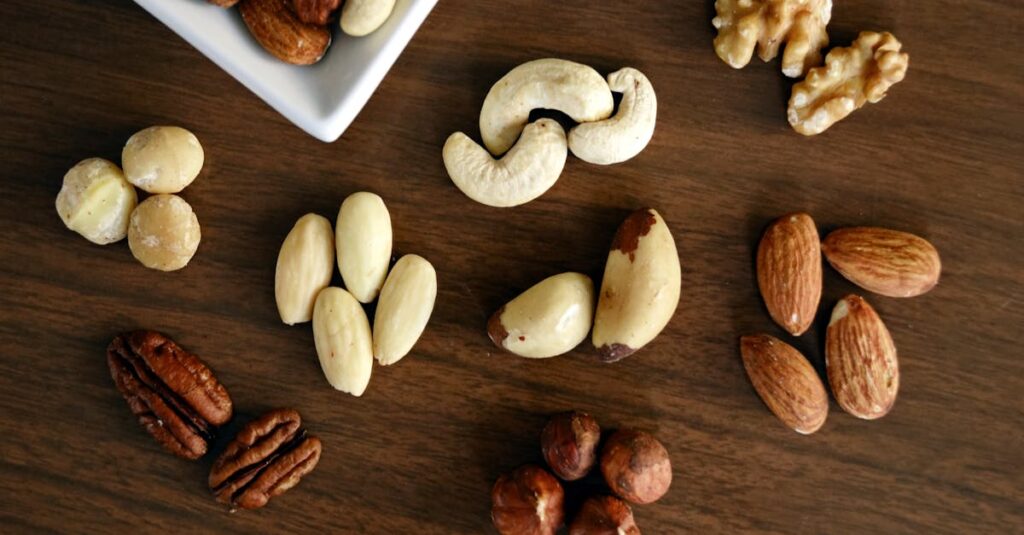
Glycemic Index & Glycemic Load
Most nuts and seeds have a very low glycemic index (GI ≤ 15–35) due to their high fat, protein, and fibre content. They significantly lower the overall glycemic response of a meal when consumed together with higher-GI foods. Starchy varieties like Makhana and Bengal Gram have a moderate GI but remain lower than white rice or refined flour.
| Nut / Seed | GI (Approximate) | GL per Serving | Implication |
|---|---|---|---|
| Peanuts / Groundnuts | 14 (Low) | ~1 | Excellent for diabetics; reduces post-meal glucose spikes when eaten before meals |
| Walnuts | 15 (Low) | ~1 | Minimal glucose impact; rich Omega-3 also reduces insulin resistance |
| Almonds | 15 (Low) | ~1 | Pre-meal almonds reduce post-meal blood glucose in clinical studies |
| Cashews | 22 (Low) | ~3 | Slightly higher due to higher carb content (30g/100g); still low GL per serving |
| Chia Seeds | 1 (Low) | ~1 | Gel formation maximally blunts glucose absorption; ideal for diabetics |
| Flaxseeds (ground) | 35 (Low) | ~2 | Mucilaginous fibre slows glucose absorption; improves insulin sensitivity |
| Sesame Seeds | 35 (Low) | ~2 | Low GL; lignans improve insulin signalling independently |
| Sunflower Seeds | 35 (Low) | ~2 | Low GI; Chlorogenic acid in seeds has anti-diabetic properties |
| Pistachios | 15 (Low) | ~4 | Studies show Pistachios specifically reduce post-meal glycaemia from bread (pistachio-bread pairing) |
| Bengal Gram (roasted) | 40 (Medium) | ~12 | Pinitol content helps offset moderate GI; fibre slows digestion |
| Makhana (Fox Nuts) | 55 (Medium) | ~16 | High starch but low fat — moderate GL; much better than puffed rice or chips |
| Lotus Seeds | 50 (Medium) | ~16 | Alkaloids may partially offset glucose absorption; still lower than refined carbs |
| Fenugreek Seeds | 25 (Low) | ~1 | 4-OH-Ile and Galactomannan make it the most anti-diabetic seed known; used therapeutically at 10–25g/day |
| Kalonji / Nigella | ~30 (Low) | ~1 | Thymoquinone improves insulin sensitivity; anti-hyperglycaemic in multiple RCTs at 2–3g/day |
💡Diabetes-Friendly Nut Strategy
Eating 30g of nuts before a carbohydrate-containing meal significantly reduces the post-meal glucose peak (clinical evidence for Almonds, Pistachios, Walnuts, and Peanuts). Adding ground Flaxseeds or Chia Seeds to rice, roti, or porridge reduces their effective GI by 20–35%. Fenugreek seed powder (5–10g) mixed with water before meals is a clinically validated strategy for type 2 diabetes management (multiple Indian RCTs, endorsed by ICMR guidelines).
Special Dietary Considerations
For Weight Management
Despite being calorie-dense, nuts are consistently associated with weight maintenance and even weight loss in epidemiological studies. The mechanisms include: (1) High satiety per calorie due to protein + fibre + fat combination; (2) Thermogenic inefficiency — actual absorbed calories are 10–25% lower than Atwater values due to cell wall matrix effect; (3) Reduced overall diet energy intake due to satiety signals; (4) Slight increase in resting metabolic rate.
- Lowest Calorie Options: Makhana (347 kcal, 0.1g fat), Lotus Seeds (332 kcal), Chestnuts (213 kcal), Fenugreek (323 kcal), Bengal Gram (390 kcal)
- Best Satiety per Calorie: Hemp Seeds (high protein + fat), Pumpkin Seeds (30g protein), Almonds (12.5g fibre + 21g protein)
- Portion Guidance: Standard 28–30g serving (one small handful of nuts) is the evidence-based daily amount associated with health benefits without excess calorie intake
For Athletic Performance
- Pre-Workout: Dates + Peanuts — fast carbs + slow protein; or Makhana (low-fat carbs with 9.7g protein)
- Recovery: Hemp Seeds — complete protein for muscle protein synthesis; Pumpkin Seeds — Zinc for testosterone and growth hormone support
- Anti-Inflammatory Recovery: Walnuts (Omega-3 + Ellagitannins) reduce exercise-induced muscle inflammation; Flaxseeds (ALA Omega-3) support inflammation resolution
- Endurance: Almond Butter — MUFA-rich energy that doesn’t spike insulin; Chia Seeds — sustained energy release + electrolytes (Ca, Mg, K)
- Magnesium for Performance: Hemp Seeds (700 mg Mg/100g) and Pumpkin Seeds (592 mg) — Magnesium deficiency is common in athletes and impairs muscle function, sleep, and recovery
For Plant-Based Diets
Nuts and seeds are nutritional pillars of vegan and vegetarian diets, filling multiple gaps that arise when animal products are removed:
- Complete Protein: Hemp Seeds (all 9 EAAs in ideal ratio)
- Calcium: Poppy Seeds, Sesame/Tahini, Chia Seeds, Almonds — can meet daily needs with regular use
- Iron: Pumpkin Seeds, Hemp Seeds, Fenugreek, Sesame — pair with Vit C for 2–3× better absorption
- Zinc: Pumpkin Seeds, Hemp Seeds, Watermelon Seeds, Cashews
- Omega-3: Flaxseeds, Chia, Walnuts, Hemp — provide ALA (though EPA/DHA conversion is limited; algae-based supplements may be needed)
- Vitamin B6: Pistachios (1.70 mg/100g) and Sunflower Seeds (1.35 mg) are exceptional plant sources
During Pregnancy
- Folate (neural tube): Peanuts (240 µg/100g), Sunflower Seeds (227 µg), Walnuts (98 µg) — critical in first trimester
- Iron: Pumpkin Seeds + Fenugreek daily, with Vit C co-consumption
- Calcium: Sesame tahini, Chia seeds, Poppy Seeds — excellent dairy alternatives
- Omega-3 DHA: ALA from Flaxseeds/Walnuts/Chia partially converts; algae DHA supplementation recommended alongside for fetal brain development
- Caution: Fenugreek in large amounts (>10g/day) should be discussed with an obstetrician as uterotonic effects have been reported. Kalonji at culinary doses is safe.
For Indian Fasting (Vrat/Upvas)
Several nuts and seeds are specifically recommended during Indian religious fasting periods, combining satiety with nutrition:
Frequently Asked Questions (FAQs)
Q1. How many nuts should I eat per day?
The evidence-based recommendation is 28–30g of mixed nuts per day (approximately one small closed handful). This is the amount used in most prospective studies showing cardiovascular, metabolic, and cognitive benefits. For seeds, 1–2 tablespoons of ground flaxseeds or chia seeds daily is practical. There is no need to strictly avoid nuts to manage weight — their high satiety means total daily calorie intake typically compensates.
Q2. Are raw nuts better than roasted?
It depends on the nutrient in question. Roasting reduces phytic acid and tannin content (improving mineral bioavailability), reduces moisture (concentrating nutrients slightly), and improves palatability. However, roasting at high temperatures (>160°C) can oxidise fragile PUFAs and degrade heat-sensitive B-vitamins. Light roasting (120–150°C) is generally considered optimal — preserving most nutrients while reducing anti-nutrients. Raw nuts retain maximum Vitamin E and Omega-3 content. For seeds particularly high in ALA (Flaxseeds, Chia), raw or cold-ground is preferred.
Q3. Which nut/seed is best for blood sugar management?
Fenugreek Seeds are the most clinically validated seed for blood glucose management — 4-Hydroxyisoleucine directly stimulates insulin secretion, and galactomannan fibre slows glucose absorption. Chia Seeds (GI: 1) and ground Flaxseeds (lignans + mucilage) are highly effective at blunting post-meal glucose spikes. Among nuts, pre-meal Almonds and Pistachios have the strongest clinical evidence for reducing post-meal glycaemia. Kalonji (Nigella) at 2–3g/day has shown significant HbA1c reduction in multiple RCTs.
Q4. Can people with nut allergies eat seeds?
Tree nut allergies (Almonds, Cashews, Walnuts, etc.) and peanut allergies are separate from seed allergies. Many people with tree nut allergies can safely eat seeds (Chia, Flax, Sunflower, Pumpkin, Hemp). Sesame allergy, however, is a distinct and increasingly common allergen — it was added to the “Big 9” major food allergens list by the FDA in 2023. Always work with an allergist to determine individual tolerances through proper testing, as cross-contamination in production facilities is common.
Q5. Should I soak nuts and seeds before eating?
Soaking (8–12 hours in water with a pinch of salt) is beneficial for most nuts and seeds. It reduces phytic acid by 20–60%, reduces tannins in walnut/almond skins, improves digestibility, and may activate enzymes (simulating germination). For flaxseeds and chia seeds, soaking causes gel formation that actually enhances their prebiotic and glucose-blunting properties. Soaking is not required for roasted or processed nuts. Seeds with very hard coats (like Watermelon, Pumpkin seeds) benefit most from soaking before roasting.
Q6. Are nuts and seeds safe for kidney stone patients?
This depends on the type of kidney stone. For oxalate stones (most common type), high-oxalate nuts should be limited: Almonds (459 mg oxalate/100g) are the highest concern. Cashews, Peanuts, and seeds are generally lower in oxalate. Paradoxically, moderate nut consumption is actually associated with lower kidney stone risk in large epidemiological studies, likely because nuts reduce urinary calcium excretion. For uric acid stones, high-purine seeds (Hemp, Pumpkin) should be moderated. Always consult a nephrologist and dietitian for personalised guidance based on your stone type and 24-hour urine analysis.
Q7. What are the best Indian nuts and seeds for daily health?
A practical daily Indian protocol: (1) Flaxseeds — 1 tbsp ground in morning roti or dahi for Omega-3 and lignans; (2) Sesame/Til — in cooking, chutney, or laddoo for calcium and lignans; (3) Peanuts — 20–30g as a snack for protein, Niacin, Folate; (4) Fenugreek seeds — sprouted or as spice daily for blood sugar control; (5) Makhana — as a low-calorie, nutritious snack replacing chips; (6) Kalonji — ¼ tsp in cooking or warm water as a traditional health tonic. This combination costs very little and covers an extraordinary range of nutritional needs.
Nutritional Highlights & Quick Reference
Highest Protein
Hemp Seeds
- ~31.6 g per 100g
- Complete amino acid profile (all 9 essential AAs)
Highest Dietary Fibre
Kalonji (Nigella Seeds)
- ~38.2 g per 100g
Highest Omega-3 (ALA)
Flaxseeds
- ~22–23 g per 100g
Highest Vitamin E
Sunflower Seeds
- ~35 mg α-TE per 100g
Highest Magnesium
Hemp Seeds
- ~650–700 mg per 100g
Highest Calcium
Poppy Seeds
- ~1400–1450 mg per 100g
Highest Iron
Fenugreek Seeds
- ~33 mg per 100g
Highest Selenium
Brazil Nuts
- ~1900 µg per 100g
- ⚠️ Limit to 1–2 nuts per day (very high selenium)
Highest Zinc
Watermelon Seeds
- ~10 mg per 100g
Highest Folate (Vitamin B9)
Peanuts (Groundnuts)
- ~240 µg per 100g
Highest Niacin (Vitamin B3)
Peanuts (Groundnuts)
- ~12 mg per 100g
Lowest Calorie Option
Chestnuts
- ~210–220 kcal per 100g
Best for Diabetics
Fenugreek Seeds
- Contains 4-hydroxyisoleucine & galactomannan
- Low glycaemic impact (GI ~25)
Best Anti-Inflammatory
Kalonji (Nigella Seeds)
- Rich in thymoquinone
- High polyphenol content (~5000+ mg/kg range)
The Diversity Principle
No single nut or seed covers every nutritional need optimally. The synergistic and complementary approach — rotating through different nuts and seeds across the week — ensures broad spectrum mineral, vitamin, fatty acid, and phytochemical coverage. A simple practical target: aim for at least 3 different nuts/seeds daily. In the Indian context, this might mean Groundnuts at snack time, Til/Sesame in cooking, and Flaxseeds ground into roti dough — achieving an extraordinary range of nutritional and medicinal benefit at very low cost.
Data Sources & References
All nutritional values in this article are derived from the following peer-reviewed, government-grade databases and publications:
- USDA FoodData Central (FDC) 2024— Primary international reference for all nuts and seeds. fdc.nal.usda.gov
- Indian Food Composition Tables (IFCT 2017)— Brahm Dutt Chattopadhyay et al., National Institute of Nutrition, ICMR, Hyderabad. Primary Indian reference. ICMR-National Institute of Nutrition, India
- Nutritive Value of Indian Foods— Gopalan C, Rama Sastri BV, Balasubramanian SC; NIN-ICMR, 2016 revised edition.
- FAO/INFOODS— International Network of Food Data Systems, Food Composition Database for Biodiversity. fao.org/infoods
- Phenol-Explorer Database v3.6— Comprehensive polyphenol composition database. phenol-explorer.eu
- Dr. Duke’s Phytochemical & Ethnobotanical Databases— USDA ARS Natural Products Lab. phytochem.nal.usda.gov
- PREDIMED Study— Estruch R et al. (2013, 2018). “Primary Prevention of Cardiovascular Disease with a Mediterranean Diet.” NEJM. doi:10.1056/NEJMoa1200303
- Kalonji / Nigella sativa Review— Butt MS et al. (2010). “Black Seeds: Nigella sativa — A Review.” Critical Reviews in Food Science & Nutrition.
- Fenugreek & Diabetes— Kassaian N et al. (2009). “Effect of fenugreek seeds on blood glucose and lipid profiles in type 2 diabetic patients.” Int J Vitam Nutr Res.
- Sesame Lignans Review— Majdalawieh AF & Mansour ZR (2019). Sesamol and sesamin. Journal of Nutritional Science.
- Flaxseed Lignan SDG— Thompson LU et al. Multiple studies, University of Toronto, on SDG and breast cancer risk.
Disclaimer
This article is intended for informational and educational purposes only. Nutritional values may vary by variety, origin, ripeness, soil conditions, processing method, and storage. Values marked as approximate are based on mean estimates from available databases. Bioavailability of listed nutrients depends significantly on anti-nutrient content, preparation method, and individual gut health. Consult a registered dietitian or physician before making dietary changes, especially if managing a medical condition. Traditional and Ayurvedic uses mentioned are for cultural context and do not constitute medical advice.
Explore More
Nutrient content of Legumes and Pulses
Nutrient content of Milk and Milk products