
Understanding Body Mass Index (BMI): A Complete Guide to Health Assessment
Body Mass Index (BMI) is a widely used medical screening tool that estimates body fat by measuring the ratio of your weight to your height, helping healthcare providers assess potential health risks and guide weight management decisions.
What is BMI?
BMI is a numerical value calculated by dividing a person’s weight in kilograms by the square of their height in meters. This simple measurement provides a general indication of whether someone falls into categories of underweight, normal weight, overweight, or obese. While BMI doesn’t directly measure body fat, it is moderately to strongly associated with other measures that capture the amount, location, and distribution of body fat in the body.
How to Calculate Your BMI
The formula for calculating BMI is straightforward: BMI = weight (kg) / height (m)².
Here’s a step-by-step guide to calculate your BMI:
- Convert your weight to kilograms (if in pounds, divide by 2.205)
- Convert your height to meters (if in inches, divide by 39.37)
- Square your height in meters (multiply height by itself)
- Divide your weight by the squared height value
For example, if you weigh 70 kilograms and are 1.75 meters tall, your BMI would be: 70 / (1.75 × 1.75) = 70 / 3.0625 ≈ 22.86.
BMI Categories and Health Implications
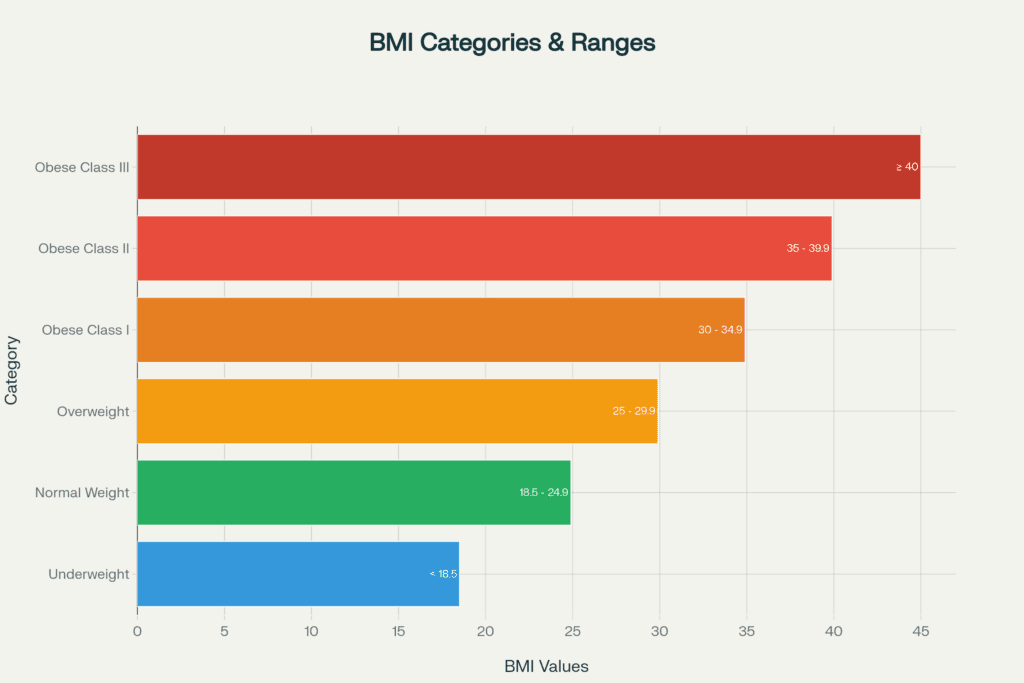
The World Health Organization defines BMI categories as follows:
- Underweight: BMI less than 18.5
- Normal weight: BMI between 18.5 and 24.9
- Overweight: BMI between 25 and 29.9
- Obesity: BMI of 30 or greater
Each category carries different health implications. A BMI of 30 or greater is associated with higher risks of type 2 diabetes, high cholesterol, high blood pressure, obstructive sleep apnea, fatty liver, osteoarthritis, and certain cancers. Research shows that the risk of death rises by 20 to 30% as BMI increases from 25 to 27 kg/m², and more steeply (by 60%) as BMI rises above 27 kg/m².
Why BMI Matters for Your Health
BMI serves as an important health indicator for several reasons. It provides a quick assessment of weight status and helps identify potential health risks associated with being overweight or underweight. High body fat may lead to heart disease, stroke, and Type 2 diabetes, while low body fat may be related to malnutrition. Healthcare providers use BMI as a starting point for discussions about weight-related health concerns and as part of a broader assessment of an individual’s health status.
BMI can also track health trends over time. A decrease in BMI corresponding to 5% of total body weight has been shown to improve health conditions such as blood pressure, cholesterol, osteoarthritis, and blood sugar levels.
Important Limitations of BMI
While BMI is a useful screening tool, it has several significant limitations:
- Doesn’t Account for Muscle Mass: Athletes and highly active individuals with increased muscle mass might have a high BMI indicating overweight or obesity, even though they have low body fat and excellent physical fitness.
- Ignores Fat Distribution: BMI doesn’t account for where fat is stored in the body. Visceral fat (fat around organs) poses more health risks than subcutaneous fat (fat under the skin), but BMI doesn’t distinguish between them.
- Variations Across Demographics: BMI might not be equally accurate for different ethnicities due to variations in body composition, and it doesn’t consider age-related changes in body composition.
- Not a Complete Health Picture: BMI alone doesn’t diagnose health conditions or provide information about cardiovascular health, diabetes risk, or other metabolic issues. Body fatness isn’t the only determiner of overall health—factors like genetics, activity level, smoking, alcohol consumption, and mental health all affect overall health.
Using BMI for Healthy Weight Management
BMI should be considered alongside other health indicators for comprehensive health assessment. Your waist circumference is actually a better predictor of health risk than BMI alone, as it measures central fat distribution. Increased abdominal obesity is related to higher risk of cardiovascular disease, type 2 diabetes, and cancer.
For effective weight management using BMI as a guide:
- Focus on a balanced diet rich in fruits, vegetables, lean proteins, whole grains, and healthy fats
- Engage in regular physical activity, including both aerobic exercises and strength training
- Make healthy lifestyle changes such as getting enough sleep, managing stress, and avoiding smoking
- Monitor other health indicators besides BMI, including waist circumference, body fat percentage, blood pressure, cholesterol levels, and blood sugar levels

Conclusion
BMI provides a quick, accessible method to assess whether your weight falls within a healthy range for your height. While it serves as a valuable screening tool for potential health risks, it’s essential to recognize its limitations and use it as part of a comprehensive health assessment. Always consult with a healthcare professional for personalized advice regarding weight management and overall health, as they can evaluate BMI alongside other measurements and your individual health history to provide the most accurate guidance.




Its like you read my mind! You seem to know so much about this, like you wrote the
book in it or something. I think that you could do with some pics to drive the
message home a little bit, but instead of that, this is great blog.
An excellent read. I will definitely be back.